Professional solutions on concrete addtives, Concrete Foaming Agent, Superplasticizer, CLC Blocks Additives, and foaming machine

AAC Block Specifications: Why Tighter Tolerances Outperform Higher Density
The Core Specification Truth
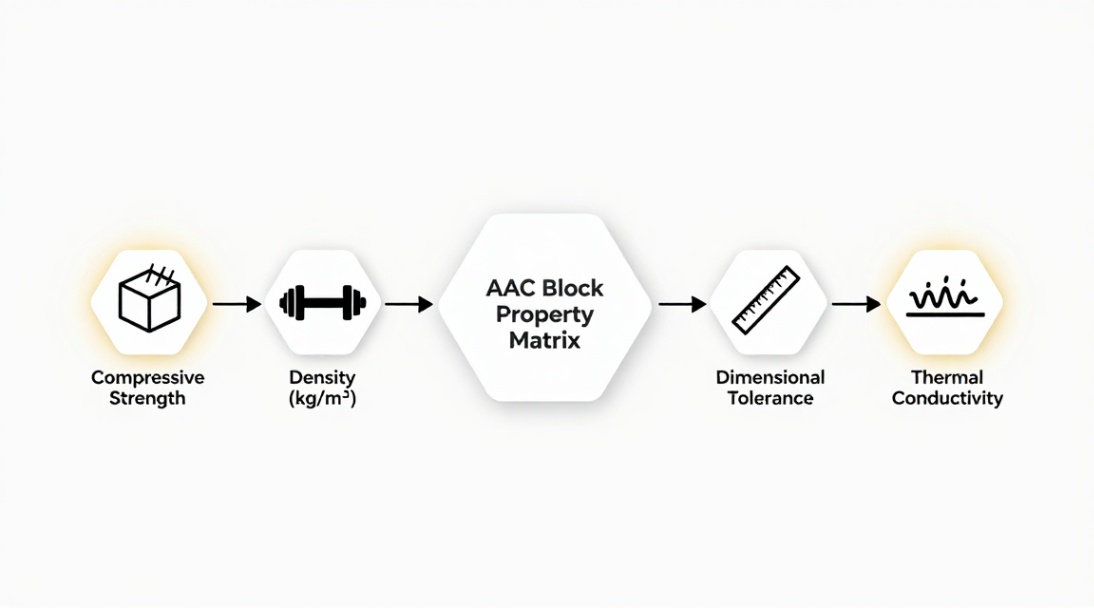
Designers often prioritize density when specifying Autoclaved Aerated Concrete (AAC). It’s a logical starting point. However, the most critical performance data often lies elsewhere. A block’s compressive strength, dimensional tolerance, and precise thermal conductivity frequently determine a wall’s success more than its weight per cubic metre. True specification mastery requires analyzing the entire property matrix, not a single datapoint.
Defining AAC: Composition and Process
Aerated Autoclaved Concrete is a precast, cellular building material. Its basic composition includes fine silica sand or fly ash, cement, lime, water, and a small amount of aluminum powder. The aluminium reacts during production, generating hydrogen gas that creates a uniform, closed-cell structure. This mass is then steam-cured in an autoclave under high pressure. The result is a material that is strong, lightweight, and packed with performance characteristics defined by its specifications.
Physical and Mechanical Properties: The Data Table
The following table provides a concise comparison of key AAC specification parameters against traditional clay bricks. This data-driven view clarifies why AAC enables different design approaches.
| Property | Typical AAC Specification Range | Traditional Clay Brick (Comparison) | Implication for Design & Construction |
|---|---|---|---|
| Dry Density | 400 – 650 kg/m³ | 1600 – 2000 kg/m³ | Reduces structural load, enables faster handling and laying. |
| Compressive Strength | 3 – 5 N/mm² (General Grade) | 10 – 30 N/mm² | AAC strength is sufficient for low-rise/mid-rise load-bearing walls; design must account for lower absolute strength. |
| Thermal Conductivity (λ) | 0.10 – 0.18 W/mK | 0.60 – 0.90 W/mK | Superior insulation often eliminates need for additional cavity insulation, simplifying wall build-up. |
| Fire Resistance Rating | Up to 4 hours (for 200mm thick block) | ~ 2 hours (for 200mm thick wall) | Meets stringent fire codes for compartmentalization with minimal thickness. |
| Sound Reduction (Rw) | 40 – 50 dB for standard partitions | 45 – 55 dB for similar mass | Good acoustic performance, but mass-sensitive; critical joints require proper sealing. |
| Drying Shrinkage | < 0.04% (per EN 12602) | Variable, can be higher | Low, predictable shrinkage minimizes post-construction cracking risk. |
Decoding Standards and Tolerances
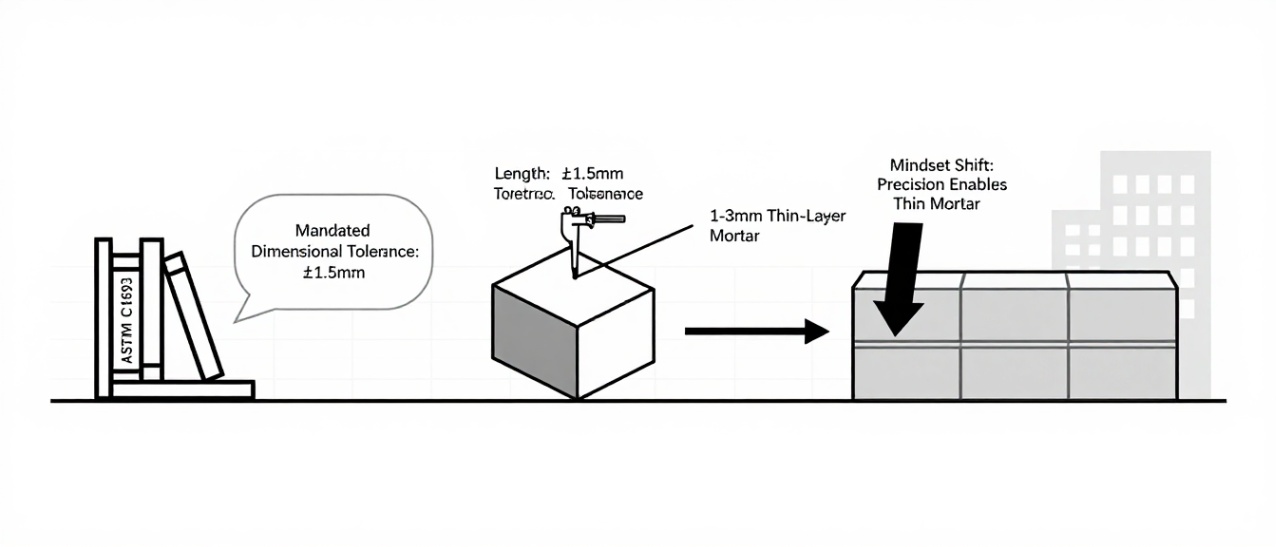
International standards govern these properties. Key documents include ASTM C1693 for AAC in North America and EN 771-4 in Europe. These standards mandate strict dimensional tolerances, often within ±1.5mm for length and height. This precision is non-negotiable. As one contractor noted in an online forum, “Switching from traditional masonry to AAC requires a mindset shift. The blocks are perfectly square and consistent. If your first course isn’t perfectly level, you’ll pay for it all the way up.” Tight tolerances enable thin-layer mortar application (1-3mm), reducing material use and thermal bridging.
Application and Structural Guidelines
AAC specifications directly dictate its use. Load-bearing walls require blocks with a minimum compressive strength, typically 4 N/mm² or higher, as defined by structural calculations. Non-loadbearing infill walls can utilize lower-strength grades. The material’s workability with standard woodworking tools allows for on-site modifications, but this demands specific, reinforced fixings designed for its friable structure, not generic wall plugs.
Sustainability and Performance Synergy
The specification story is incomplete without sustainability. AAC’s thermal efficiency directly reduces operational carbon. Its primary raw material is often industrial by-product (fly ash). The autoclaving process locks in performance, creating a durable wall system with a long service life. This combination of high recycled content, operational energy savings, and durability forms a compelling environmental profile that modern green building codes recognise.
Specification in Practice: The Critical Step
Selecting the right AAC block grade is the first decision. The next, equally critical step is detailing and execution. Specification requires complementary systems: specialized thin-bed mortar, structural reinforcement where needed, and appropriate surface finishes that respect the material’s vapor permeability. A detailed technical datasheet from a reputable manufacturer is the essential starting point. It provides the guaranteed minimum values for density, strength, and thermal performance upon which your design calculations must rely. Always verify that the proposed blocks carry certification against relevant standards (ASTM or EN). This due diligence transforms generic material properties into a predictable, high-performance building envelope. For complex projects, consulting with an AAC specialist or manufacturer’s technical team during the design phase can preempt installation challenges and optimize cost-performance.
We are the global leader in lightweight concrete and advanced engineered foam solutions. Known globally for its commitment to research, innovation, and applied expertise, we have been providing engineered foam solutions since the early 2012’s.
We can supply high-quality concrete admixture and foam concrete related products all over the world.
The company has a professional technical department and quality supervision department, a well-equipped laboratory, and equipped with advanced testing equipment and after-sales customer service center.
If you are interested, please feel free and contact us.