Professional solutions on concrete addtives, Concrete Foaming Agent, Superplasticizer, CLC Blocks Additives, and foaming machine

Choosing the Right AAC Block: A Technical Specification Guide for Architects and Builders
Your Guide to AAC Block Specifications
Are you specifying materials for a new building project? The structural integrity, energy efficiency, and build timeline depend on your choice. Traditional clay bricks and dense concrete blocks present familiar challenges: weight, poor insulation, and slow installation. Aerated Autoclaved Concrete (AAC) offers a modern alternative. But navigating the technical specifications is critical to ensure performance meets design intent. This guide provides a data-driven comparison of AAC block specifications against conventional materials to aid your selection process.
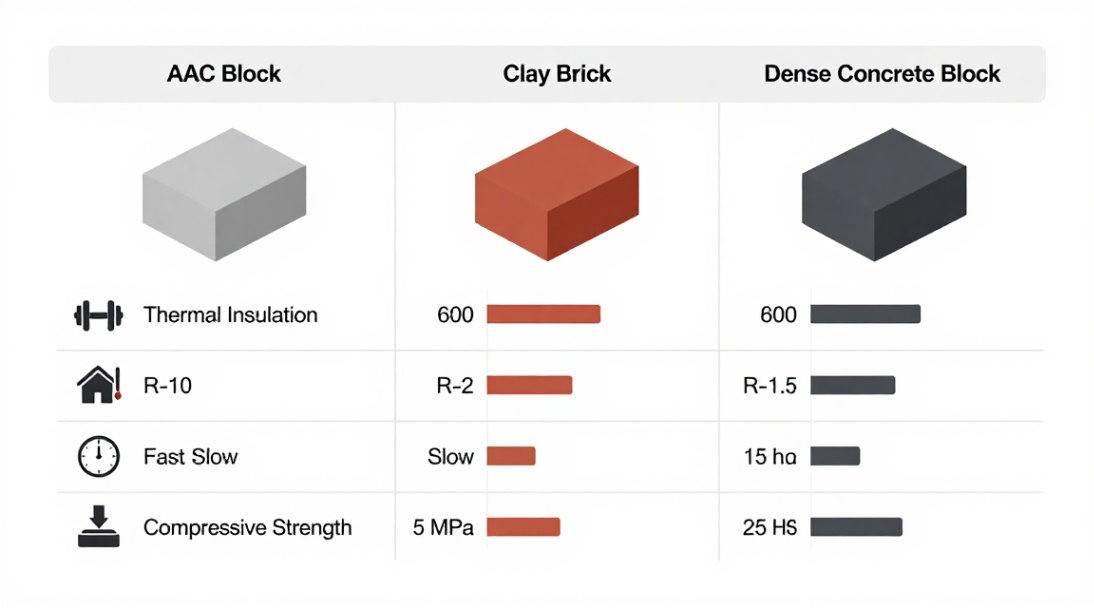
AAC Block Core Specifications: The Technical Foundation
Aerated Autoclaved Concrete is a lightweight, precast building material. It combines fine silica sand, cement, lime, water, and an expansion agent, typically aluminum powder. The mixture rises like bread dough, creating millions of tiny, closed air cells. The material is then autoclaved-cured under high-pressure steam-which gives AAC blocks their final strength and dimensional stability. This unique process defines their key specifications.
Essential Physical and Mechanical Properties
Performance hinges on three primary properties: density, compressive strength, and thermal conductivity. These values are intrinsically linked and drive most application decisions.
- Density: Ranges from approximately 400 kg/m³ to 800 kg/m³. Lower density blocks offer better thermal insulation but lower load-bearing capacity.
- Compressive Strength: Varies from 2.5 MPa to 7.5 MPa, correlating with density. Standard 600 kg/m³ blocks typically achieve strengths around 3.5-4.5 MPa.
- Thermal Conductivity (k-value): Ranges from 0.10 to 0.20 W/mK. A standard 200mm AAC wall can achieve a U-value below 0.30 W/m²K, exceeding most building code insulation requirements.
Dimensional Tolerances and Structural Performance
AAC blocks are precision-manufactured. Standard dimensions include lengths of 600-625mm, heights of 200-250mm, and thicknesses from 75mm to 300mm. Tolerances for length and height are typically ±1.5mm to ±2mm. This precision allows for thin-bed mortar application and faster, more accurate construction. AAC masonry offers excellent fire resistance, with 100mm blocks providing up to 4 hours of fire rating, and sound insulation properties exceeding 45 dB for standard wall assemblies.
AAC Blocks vs. Traditional Materials: A Specification Comparison
Choosing the right material requires comparing the data side-by-side. The following table breaks down key performance specifications across AAC, clay brick, and dense concrete block.
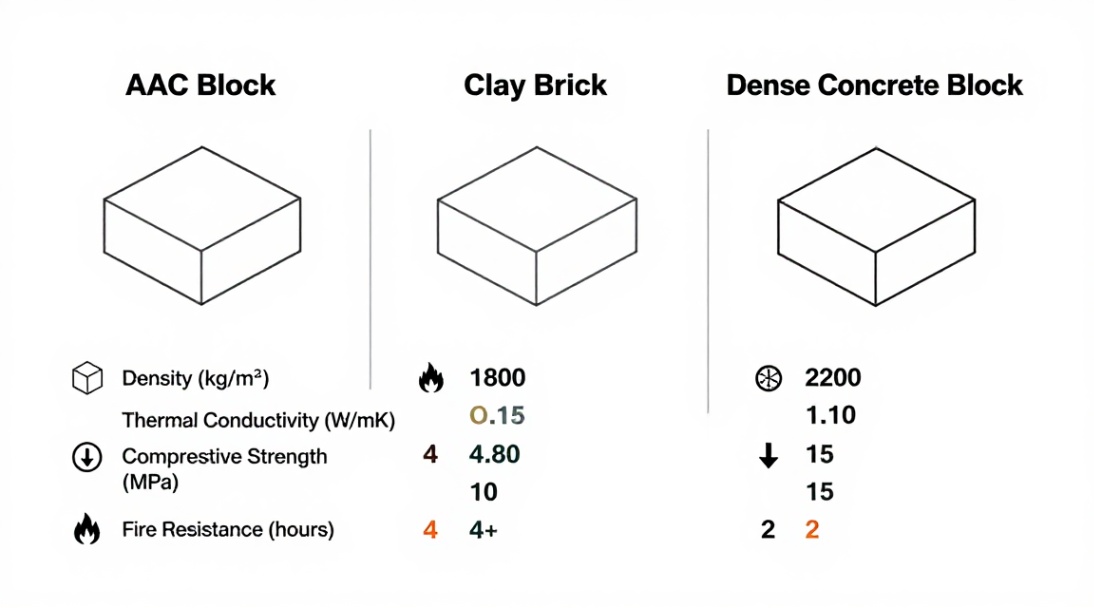
Material Performance Specifications Comparison
| Specification | AAC Blocks (Standard Grade) | Clay Bricks | Dense Concrete Blocks |
|---|---|---|---|
| Typical Density | 600-650 kg/m³ | 1800-2000 kg/m³ | 1800-2200 kg/m³ |
| Compressive Strength | 3.5 – 4.5 MPa | 10 – 35 MPa | 7 – 25 MPa |
| Thermal Conductivity (k-value) | 0.15 – 0.18 W/mK | 0.70 – 0.90 W/mK | 0.70 – 1.30 W/mK |
| Fire Resistance (100mm wall) | Up to 4 hours | ~2 hours | ~2-3 hours |
| Water Absorption | 10-15% by mass | 15-20% by mass | 7-10% by mass |
| Standard Block Weight | ~15 kg (for 625x250x200mm) | ~25 kg | ~18-22 kg |
Decision Analysis: Advantages and Limitations
Use this table to weigh functional benefits against practical constraints for your specific project phase and goals.
| Aspect | Advantages of AAC Blocks | Limitations & Considerations |
|---|---|---|
| Structural & Insulation | Combines load-bearing and insulation in a single element. Excellent thermal mass reduces HVAC loads. | Lower compressive strength than dense concrete. Requires structural design validation for high-rise or high-load applications. |
| Construction Speed | Large, lightweight blocks and thin-bed mortar speed erection. Easy to cut and shape on-site. | Initial material cost can be higher. Requires skilled labor familiar with thin-bed mortar techniques and specialized fixings. |
| Durability & Environment | Inorganic, rot-proof, and pest-resistant. High resource efficiency, often containing recycled fly ash. Low embodied energy. | Higher initial moisture content requires protection from rain during storage and construction. Requires a rendered or clad finish for prolonged weather exposure. |
| Fire & Acoustic Performance | Superior fire rating due to inorganic composition. Good sound insulation from porous structure. | Acoustic performance for impact sound (footfall) may require additional floating floor assemblies. |
Implementation Guidelines and Standards Compliance
Proper handling ensures AAC performs to specification. Always specify AAC blocks according to established standards like ASTM C1693 (Standard Specification for Autoclaved Aerated Concrete) or EN 771-4. On-site, store blocks off the ground under cover. Use polymer-modified thin-bed mortar for laying. For fixings, always use purpose-designed nylon or metal anchors designed for low-density masonry-standard wall plugs will fail. Cutting is straightforward with a handsaw or band saw. For load-bearing walls, consult structural calculations based on the declared compressive strength class, not just density.
When to Specify AAC Blocks
Specify AAC as the primary walling material for mid-rise residential, commercial, and institutional buildings where speed of construction and energy efficiency are priorities. It is ideal for infill walls in framed structures and partition walls. For foundations, retaining walls, or areas with constant moisture exposure, specify dense concrete or other waterproofed systems. In seismic zones, ensure the structural design incorporates AAC’s specific seismic detailing requirements.

Final Recommendations
Select AAC blocks when your project prioritizes thermal performance, construction speed, and lightweight design. The specification process demands attention to the strength-density relationship and proper detailing for moisture protection and fixings. For high-load or below-grade applications, traditional dense concrete often remains the necessary choice. The data shows AAC is not a universal replacement but a superior system for its intended applications. To proceed, obtain certified test reports from your AAC supplier for the specific product batch, focusing on compressive strength, density, and drying shrinkage values. Validate these against your project’s structural and thermal models before finalizing your specifications.
We are the global leader in lightweight concrete and advanced engineered foam solutions. Known globally for its commitment to research, innovation, and applied expertise, we have been providing engineered foam solutions since the early 2012’s.
We can supply high-quality concrete admixture and foam concrete related products all over the world.
The company has a professional technical department and quality supervision department, a well-equipped laboratory, and equipped with advanced testing equipment and after-sales customer service center.
If you are interested, please feel free and contact us.