Professional solutions on concrete addtives, Concrete Foaming Agent, Superplasticizer, CLC Blocks Additives, and foaming machine

Foamed Concrete Mix Design for Floor Screeding: Cutting Through the Industry Hype
What is Foamed Concrete Mix Design for Floor Screeding?
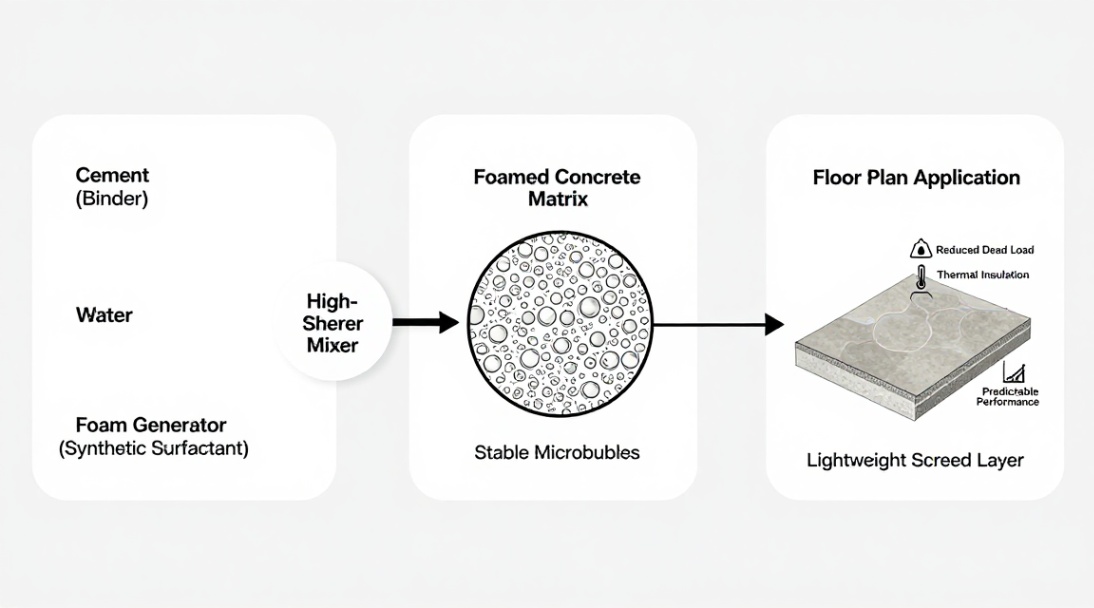
Foamed concrete mix design for floor screeding is the systematic, data-driven process of proportioning cement, water, and pre-formed foam to create a stable, lightweight, and insulating floor layer with predictable performance. Forget the vague talk of “magic formulas.” This is cold, hard materials science applied to solve specific construction problems: excessive dead load, poor thermal performance, and complex leveling. The foam, typically generated from a synthetic surfactant, introduces millions of microscopic, stable air bubbles. These bubbles displace solid material, radically reducing density. The mix designer’s job is to control this aeration to hit a target density while ensuring the paste has enough strength to hold the bubbles without collapse.
The Core Components: It’s Not Just Cement and Bubbles
Most discussions start with cement. That’s a mistake. The single most critical component in foamed concrete mix design for floor screeding is the foam itself. Everything else supports its stability. The base slurry-cement, water, and often supplementary cementitious materials (SCMs) like fly ash or silica fume-must be engineered to have the right viscosity and setting characteristics to encapsulate and retain the air. Admixtures, particularly superplasticizers, are non-negotiable for achieving flow at low water-cement ratios. Fibres (polypropylene or glass) are frequently added to mitigate plastic shrinkage and enhance toughness. The table below breaks down the non-negotiable roles of each component.
Material Functions in the Mix
| Component | Primary Role | Critical Consideration |
|---|---|---|
| Cement | Binder, provides ultimate strength. | Type and fineness affect early strength gain and stability. |
| SCMs (Fly Ash, Slag) | Enhances long-term strength, improves pumpability, reduces cost. | Can slow early set; requires careful proportioning with cement. |
| Water | Enables hydration and workability. | Water-to-cement ratio is paramount. Too high weakens structure; too low prevents flow. |
| Pre-formed Foam | Creates the cellular structure, dictates density. | Stability is everything. Foam must survive mixing, pumping, and placing. |
| Superplasticizer | Disperses cement particles, allows low water content. | Essential for high-flow, stable mixes. Compatibility with foam agent is key. |
| Fibres | Controls plastic shrinkage cracking, adds residual flexural strength. | Dosage and dispersion are critical to avoid balling and surface finish issues. |
Density is Your North Star
In conventional concrete, you design for strength. In foamed concrete for screeds, you design for target dry density (often between 600-1200 kg/m³). Strength follows density. This is the first principle most contractors get wrong. They chase a compressive strength number without controlling the variable that dictates it: air content. The density dictates every functional property: thermal insulation (lower density = better ‘k’ value), compressive strength, modulus of elasticity, and dead load. Your mix design process starts here. Specify the required density first, based on structural and thermal specs, then work backwards to determine the foam volume.
The Mix Design Methodology: A Practical Blueprint
Theoretical calculations provide a starting point. Reality is proven in the trial batch. Here is a stripped-down, no-nonsense methodology that challenges the over-complicated academic approaches.
- Define Required Properties: Set your non-negotiable targets: Dry Density (e.g., 800 kg/m³), compressive strength (e.g., 7 MPa at 28 days), flowability (e.g., 200mm slump flow).
- Establish Base Slurry Proportions: Determine a water-cement ratio (typically 0.40-0.55) that will give you the necessary paste strength. Incorporate SCMs if specified. Use a superplasticizer to achieve target flow at this w/c ratio.
- Calculate Foam Demand: This is the core calculation. Based on the densities of your slurry components and your target fresh density, calculate the required volume of foam per cubic metre of mix. This dictates your foam generator output settings.
- Conduct Trial Batches (The Only Truth): Mix the base slurry. Generate stable foam separately. Combine incrementally, measuring fresh density constantly until you hit your target. Cast test specimens.
- Test & Iterate: Measure fresh properties (flow, stability, segregation). Test hardened specimens for density and strength. Adjust foam quality or slurry viscosity as needed. Repeat until all targets are met consistently.
Critical Fresh Properties: Where Screeds Succeed or Fail
Compressive strength is a final cheque. Failure happens in the fresh state. You must ruthlessly control three properties on site:
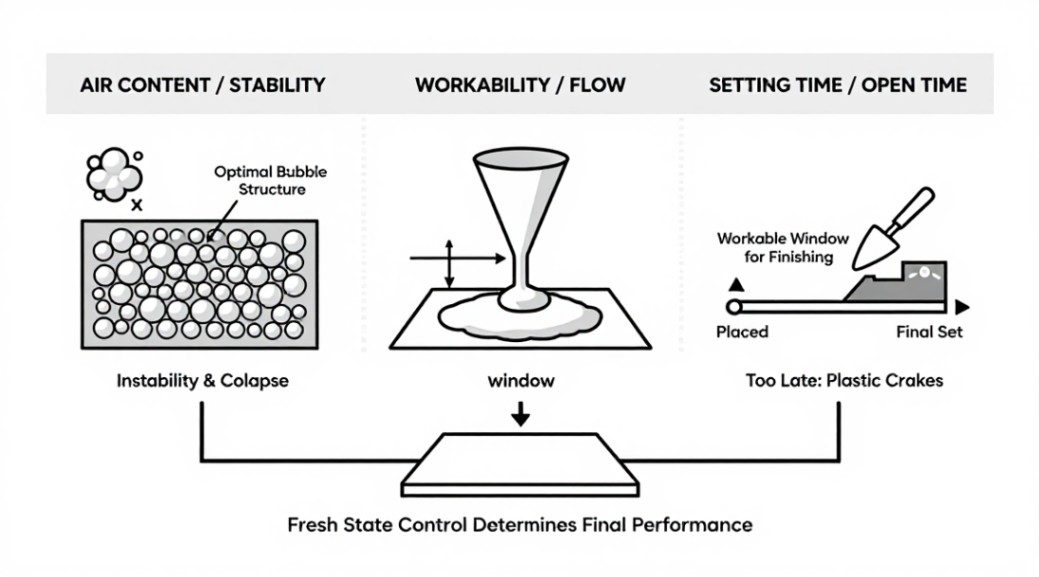
- Flowability: The mix must be self-levelling. But flow is useless without stability.
- Stability (Bleeding & Segregation): Zero tolerance. If water bleeds out or the mix separates, the density profile is ruined, leading to weak spots.
- Setting Time: Must be predictable and compatible with site logistics-fast enough to allow timely finishing, slow enough to allow placement of large pours.
As industry veteran and materials engineer Dr. Alistair Greene states: “A foamed concrete screed mix that segregates in the wheelbarrow is already a failure. The design phase must guarantee stability under site conditions, not just in a lab mixer.” This insight separates theoretical mix design from practical application.
Application Truths: Placing, Finishing, and Curing
The best foamed concrete mix design for floor screeding is worthless if placed poorly. This material is not traditional concrete. Do not treat it as such.
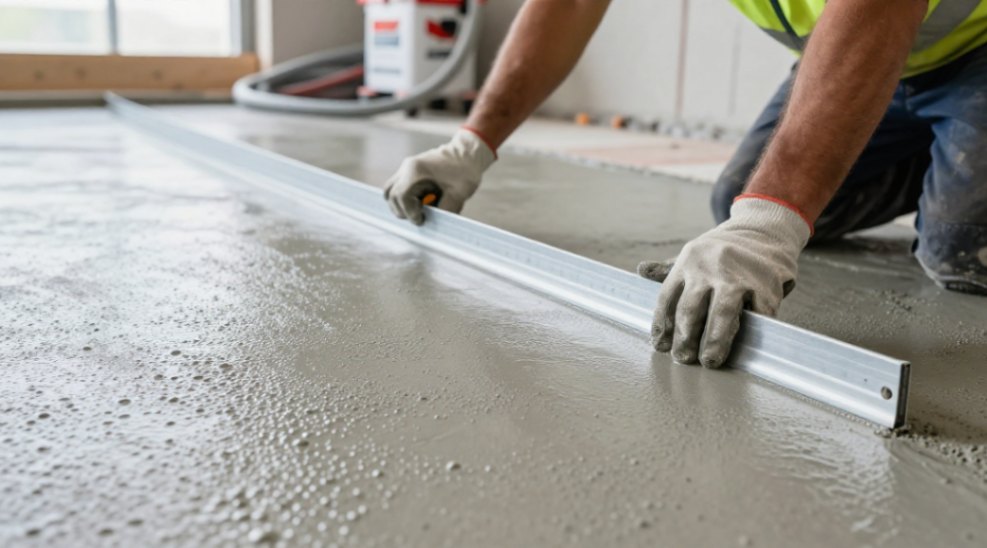
- Placing: Pumping is standard. Ensure the pump line is lubricated with slurry first. Place continuously to avoid cold joints. Do not over-vibrate or overwork-you will collapse the bubble structure.
- Finishing: A straightedge or darning float is often sufficient for levelling. Power trowels can be used cautiously on higher-density mixes (>1000 kg/m³), but start late and be gentle to avoid tearing the surface and drawing fines.
- Curing: This is non-negotiable. The high surface area and low water content make foamed concrete prone to rapid moisture loss. Apply a curing membrane or wet curing immediately after finishing to prevent plastic shrinkage cracks and ensure full strength development.
Cutting Through Specs and Standards
Compliance is not a goal; it’s a baseline. Key standards like BS EN 13813 and ASTM C796 provide test methods for fresh density, flow, and compressive strength. Your mix design must be demonstrably compliant. But here’s the counterintuitive perspective: meeting the standard is the easy part. The real challenge is designing a mix that also survives the variables of a real-world site-temperature changes, delays, substrate conditions-and still performs. That requires a deeper understanding than any standard can prescribe. Start with the density. Master the foam. Validate with trials. Your screed will perform.
We are the global leader in lightweight concrete and advanced engineered foam solutions. Known globally for its commitment to research, innovation, and applied expertise, we have been providing engineered foam solutions since the early 2012’s.
We can supply high-quality concrete admixture and foam concrete related products all over the world.
The company has a professional technical department and quality supervision department, a well-equipped laboratory, and equipped with advanced testing equipment and after-sales customer service center.
If you are interested, please feel free and contact us.