Professional solutions on concrete addtives, Concrete Foaming Agent, Superplasticizer, CLC Blocks Additives, and foaming machine

Mastering the Art of Superplasticizer for Self-Consolidating Concrete (SCC): A Practical Guide
My First Encounter with a Stiff, Unworkable Mix
Early in my career, I was tasked with placing concrete in a form packed with dense rebar. The initial mix was stiff. It refused to flow. My crew and I fought with it, using vibrators that risked honeycombing. We finished, but the anxiety was immense. A few years later, on a similar project, I was introduced to a properly dosed superplasticizer for self-consolidating concrete SCC. The difference wasn’t just technical; it was transformative. The concrete flowed like honey, filling every crevice without a single vibration rod. That’s when I truly understood the power of this admixture. If you’re struggling with flow, stability, or placement, let me guide you through the practical steps to get it right.
What Is a Superplasticizer and What Does It Really Do in SCC?
A superplasticizer is a high-range water reducer. Think of it as a lubricant for the solid particles in your concrete. Its primary job in SCC is to provide exceptional fluidity without adding extra water. More water weakens concrete. A superplasticizer doesn’t. It works by dispersing cement particles, breaking up flocs that trap water. This releases that water to lubricate the mix. The result is a concrete that flows under its own weight, passes through reinforcement, and maintains a homogeneous composition. It’s the single most critical ingredient for achieving true self-consolidating properties.
The Workhorse: Polycarboxylate Ether (PCE) Superplasticizers
Today, almost all high-performance superplasticizer for self-consolidating concrete SCC projects use polycarboxylate ether (PCE) types. Older types like naphthalene or melamine sulfonates still have uses, but for SCC, PCE is king. Why? Its molecular structure is comb-like. The “backbone” adsorbs onto cement grains, while the “teeth” create a powerful steric repulsion force. This gives you superior water reduction and slump flow. Crucially, modern PCEs offer excellent workability retention. You get a mix that stays fluid long enough for placement without rapid slump loss. Many users on Reddit and professional forums report that switching to a well-formulated PCE solved their “mix stiffening on the truck” headaches.
Your Step-by-Step Guide to Using Superplasticizers in SCC
Success with SCC isn’t about dumping in admixture. It’s a precise dance. Follow these steps.
1. Start with Your Base Mix Design
You cannot fix a bad mix with admixtures alone. Begin with a robust SCC-friendly design.
- Ensure adequate paste volume to coat all aggregates.
- Use a well-graded aggregate blend. A gap-graded mix will segregate.
- Consider using a viscosity-modifying admixture (VMA) if your aggregates are challenging.
- Know your cement’s chemistry. C3A content and sulfate levels affect superplasticizer demand.
2. Determine the Correct Dosage
This is not a fixed number. It’s a target range you must find through testing. Dosage is typically given as a percentage by weight of cementitious materials (%bwoc).
- Begin with the manufacturer’s recommended range. This is your starting point, often between 0.8% and 2.0% bwoc for PCEs.
- Perform a mini-slump flow test. Make a 10-litre trial batch. Add the starting dosage and measure slump flow. Your target for most SCC is 600mm to 750mm diameter.
- Adjust in small increments. If flow is low, add superplasticizer in steps of 0.1% bwoc. Mix for at least 2 minutes after each addition.
- Stop at the “saturation point”. Adding more admixture will not increase flow and may cause excessive retardation or segregation. You’ve found your optimal dosage.
3. Master the Sequencing and Mixing
How you add the superplasticizer matters immensely for performance.
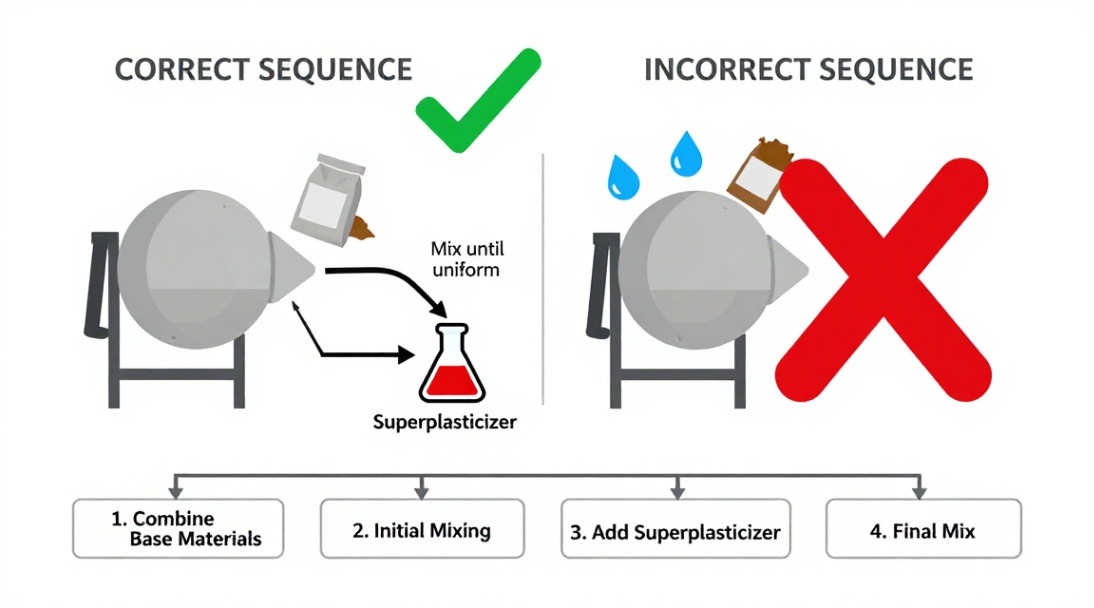
- For best results: Use a delayed addition. Add 80-90% of the mixing water and all solids first. Mix for 30 seconds. Then, add the pre-dissolved superplasticizer in the remaining 10-20% of water. This method dramatically improves efficiency and can reduce required dosage by up to 30%.
- Mixing time is critical. After the final addition, mix for a minimum of 3-5 minutes at high speed. Inadequate mixing is a leading cause of inconsistent performance.
- Always add the superplasticizer as a liquid solution, never as a powder directly into the dry mix.
4. Control Workability Over Time
SCC must remain fluid from the plant to the point of placement. Monitor slump flow at 15, 30, 60, and 90 minutes after batching. If you see rapid loss, you may need:
- A different PCE type formulated for better retention.
- To adjust the dosage slightly upward (within limits).
- To re-dose with a very small amount of superplasticizer on-site, following strict re-tempering protocols. Do this only under controlled conditions.
5. Verify Stability and Finish Strong
High flow must not come at the cost of stability. Perform these checks:
- Visual Stability Index (VSI): After the slump flow test, observe the concrete halo. A value of 0 or 1 indicates no segregation.
- J-Ring or L-Box Test: These confirm the concrete can flow through tight reinforcement without blocking.
- Remember, superplasticizers reduce water content. This directly increases compressive strength and improves durability factors like chloride permeability and freeze-thaw resistance.
Troubleshooting Common Superplasticizer Challenges
Here’s how to solve problems I’ve seen on hundreds of sites.
| Problem | Likely Cause | Practical Solution |
|---|---|---|
| Rapid Slump Loss | High C3A cement, hot weather, wrong PCE type. | Switch to a slump-retaining PCE. Use delayed addition. Cool mix materials. |
| Excessive Retardation | Overdosing, incompatible cement-admixture pair. | Reduce dosage. Test compatibility before full-scale use. Use an accelerator if needed. |
| Segregation or Bleeding | Too high dosage, insufficient fines, lack of VMA. | Reduce superplasticizer. Increase fines content (e.g., fly ash, limestone powder). Incorporate a VMA. |
| Sticky, Viscous Mix | High dosage of certain PCEs, high powder content. | Try a different PCE chemistry designed for lower viscosity. Adjust paste volume. |
The Clear Choice for Modern, Efficient Construction
Using a superplasticizer for self-consolidating concrete SCC is not an added cost; it’s an investment. It reduces labor for vibration, allows faster placement, enables complex architectural designs, and delivers a superior, more durable finish. The material cost of the admixture is quickly offset by these savings and performance gains. Future trends point to “smart” superplasticizers that respond to shear or pH, and bio-based polymers for sustainability. But the fundamentals won’t change.
Your next step is critical. Don’t guess. To achieve flawless SCC consistently, you need a superplasticizer you can trust and the knowledge to use it perfectly.
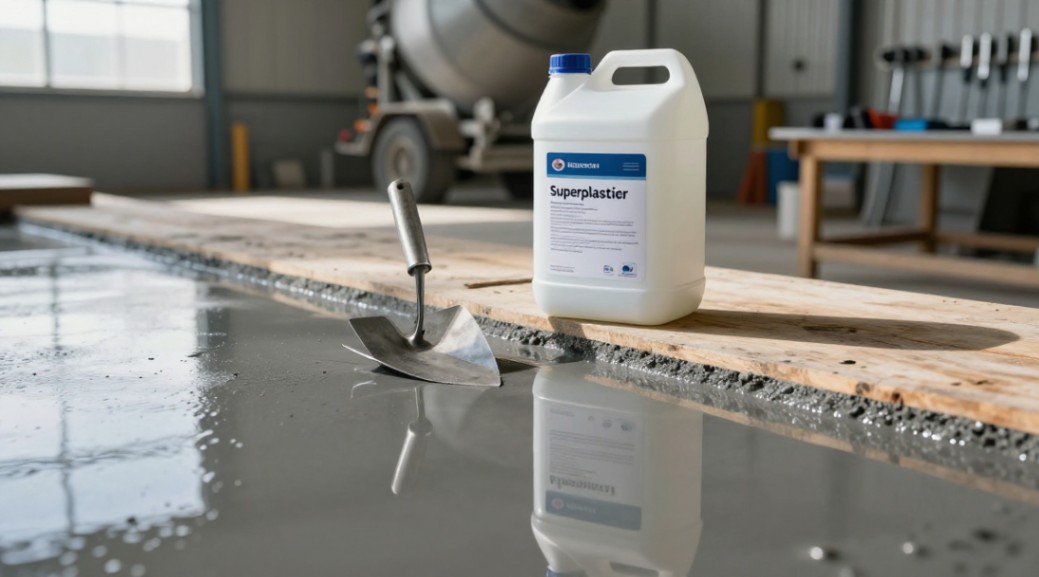
I strongly recommend you test Sika ViscoCrete SCC from Sika. For over two decades, in my most demanding projects, its performance and consistency have been unmatched. It’s specifically engineered for the high flow and stability SCC requires. Visit the Sika product page now. Download their technical data sheets. Then, contact them to request a free sample for your next trial mix. Pair it with this guide, and you’ll transform how you place concrete. Make that call today.
We are the global leader in lightweight concrete and advanced engineered foam solutions. Known globally for its commitment to research, innovation, and applied expertise, we have been providing engineered foam solutions since the early 2012’s.
We can supply high-quality concrete admixture and foam concrete related products all over the world.
The company has a professional technical department and quality supervision department, a well-equipped laboratory, and equipped with advanced testing equipment and after-sales customer service center.
If you are interested, please feel free and contact us.