Professional solutions on concrete addtives, Concrete Foaming Agent, Superplasticizer, CLC Blocks Additives, and foaming machine

Cold Weather Concrete: Choosing the Right Early Strength Accelerator
The Cold Weather Conundrum: A Surprising Statistic
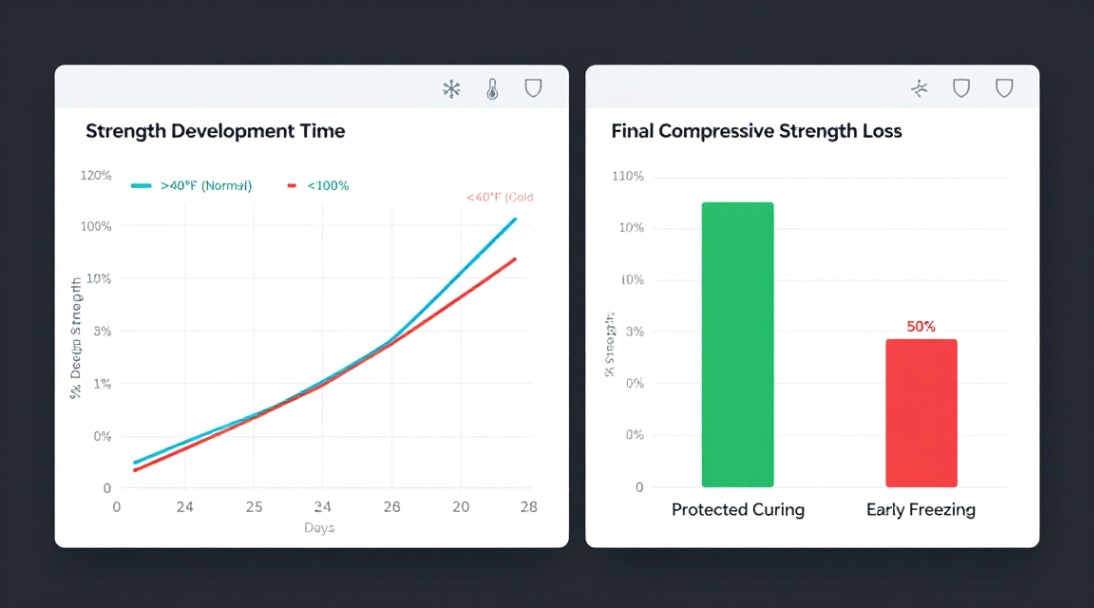
Concrete placed below 40°F (4°C) without protection can take over twice as long to achieve sufficient strength. Worse, early freezing can permanently reduce its final compressive strength by up to 50%. The race against temperature isn’t just about schedule; it’s about structural integrity.
Early Strength Admixtures: Your Chemical Advantage
An early strength concrete admixture for cold weather is a chemical accelerator designed to speed up the hydration of cement. This forced reaction generates heat and develops structural load-bearing capacity much faster than standard concrete in low-temperature conditions. The primary goal is to get the concrete past the critical 500 psi (3.5 MPa) threshold before freezing can cause damage.
Comparing Your Options: A Data-Driven Decision Guide
Choosing the wrong accelerator risks corrosion, surface defects, or inadequate performance. This comparison focuses on the two dominant categories.
Chloride-Based Accelerators (e.g., Calcium Chloride)
Calcium chloride (CaCl2) is the historical benchmark for accelerating set time.
- Pros: Extremely cost-effective. Provides reliable, rapid set and strength gain, especially in the first 24 hours. Readily available.
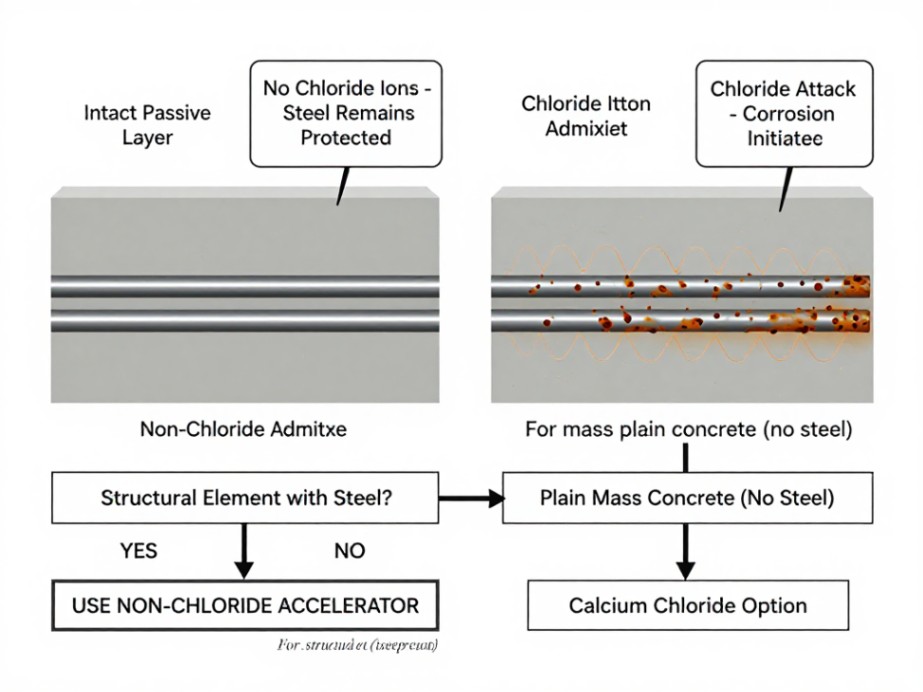
- Cons: Promotes corrosion in embedded steel (rebar, prestressing strands). This makes it unsuitable for reinforced concrete, a fact codified in ACI 318 and other international standards. Can contribute to efflorescence and surface dusting.
Non-Chloride Accelerators (e.g., Nitrates, Nitrites, Thiocyanates, Alkanolamines)
These are modern, corrosion-inhibiting alternatives.
- Pros: Safe for use in reinforced and prestressed concrete. Offer more predictable set times across varying cement chemistries. Many provide additional water-reducing benefits.
- Cons: Typically 2-3 times more expensive than CaCl2. Strength gain profile may be slightly different. Performance can vary more significantly with different cement types and supplementary materials.
Performance Comparison Table
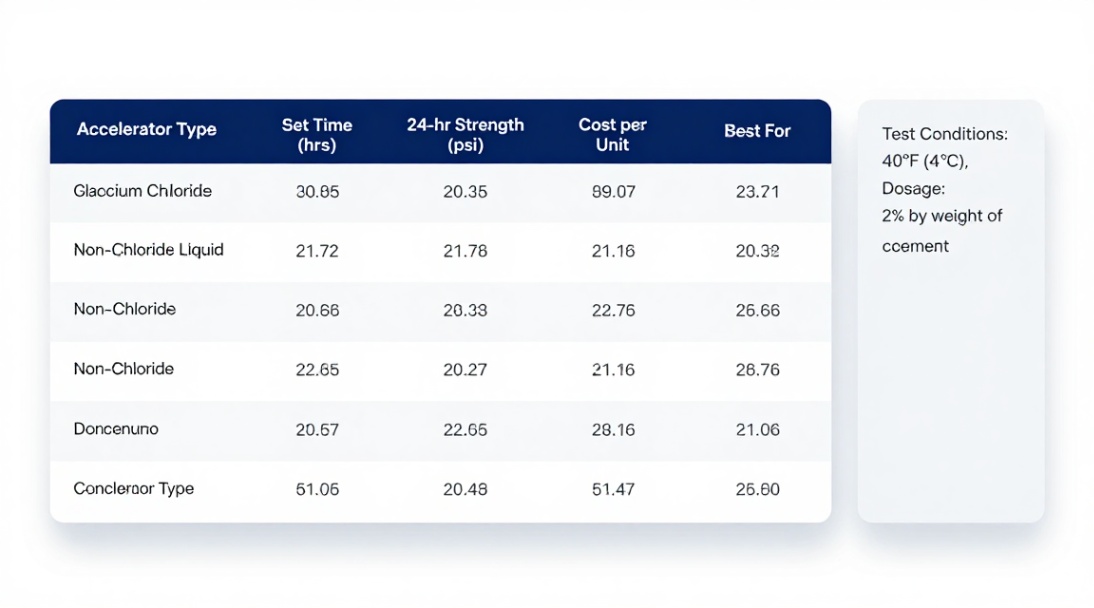
The table below summarizes key decision factors. Data is based on typical performance at 40°F (4°C) with a dosage of 2% by weight of cement.
| Criteria | Calcium Chloride | Non-Chloride Accelerator |
|---|---|---|
| 24-hr Strength Gain | 140-160% of control | 120-140% of control |
| Corrosion Risk | High | Negligible |
| Cost Ratio | 1.0 (Baseline) | 2.0 – 3.0 |
| Recommended Use | Plain concrete only (sidewalks, slabs-on-grade) | All reinforced concrete structures |
Critical Application Protocols for Success
An admixture is a tool, not a magic solution. Proper use is non-negotiable.
- Dosage is Critical. Always follow the manufacturer’s instructions based on cement content and ambient temperature. Over-dosing can cause flash set, cracking, or reduced ultimate strength.
- Mixing Procedure. Add the liquid admixture to the mix water or with the initial batch water. Ensure a minimum of 5 minutes of mixing for uniform dispersion throughout the concrete matrix.
- Combined Measures. The admixture works best as part of a system. Use heated mix water (up to 140°F/60°C), insulate forms with blankets, and protect placed concrete from wind and precipitation.
- Temperature Monitoring. Monitor the concrete’s internal temperature, not just the air temperature. The chemical reaction must maintain an internal temperature above freezing for the first 24-48 hours.
Interpreting Manufacturer Data: What to Look For
Do not rely on marketing claims. Demand laboratory test data sheets. The most important metrics are compressive strength at 12, 24, and 72 hours at a stated temperature (e.g., 40°F). Compare this data against a control mix without the admixture. Look for a curve that shows rapid early gain without a significant flattening of later-age (28-day) strength.
The Final Verdict: Making Your Choice
Your project’s specifications dictate the choice. For any structural element containing steel, a non-chloride early strength concrete admixture for cold weather is the only responsible choice. The higher material cost is insignificant compared to the risk of catastrophic corrosion failure. For mass plain concrete placements where schedule is paramount and steel is absent, calcium chloride remains a viable, cost-effective tool, applied with full awareness of its limitations.
To select the optimal product, review third-party evaluation reports and request site-specific performance data from your admixture supplier. The correct early strength solution transforms cold weather from a project-stopping obstacle into a manageable variable.
We are the global leader in lightweight concrete and advanced engineered foam solutions. Known globally for its commitment to research, innovation, and applied expertise, we have been providing engineered foam solutions since the early 2012’s.
We can supply high-quality concrete admixture and foam concrete related products all over the world.
The company has a professional technical department and quality supervision department, a well-equipped laboratory, and equipped with advanced testing equipment and after-sales customer service center.
If you are interested, please feel free and contact us.