Professional solutions on concrete addtives, Concrete Foaming Agent, Superplasticizer, CLC Blocks Additives, and foaming machine

7 Critical Factors for Choosing the Right Concrete Foaming Agent
Is Your Lightweight Concrete Letting You Down?
Have you spent hours mixing, only to watch your foam collapse before your eyes? Or maybe your lightweight concrete came out heavier than intended, with pockets of dense material ruining the insulation? You are not alone. Many professionals on platforms like Reddit share the same frustrations: bubbles that disappear, foam that leaks oil, and a final product that simply fails to meet the required strength. Getting the foam right is the hardest part of making foamed concrete. It is the core of the process. Your entire project hinges on one crucial component: the Concrete Foaming Agent. This guide compares the main types, breaks down their real-world performance, and helps you pick the right one for your next pour.
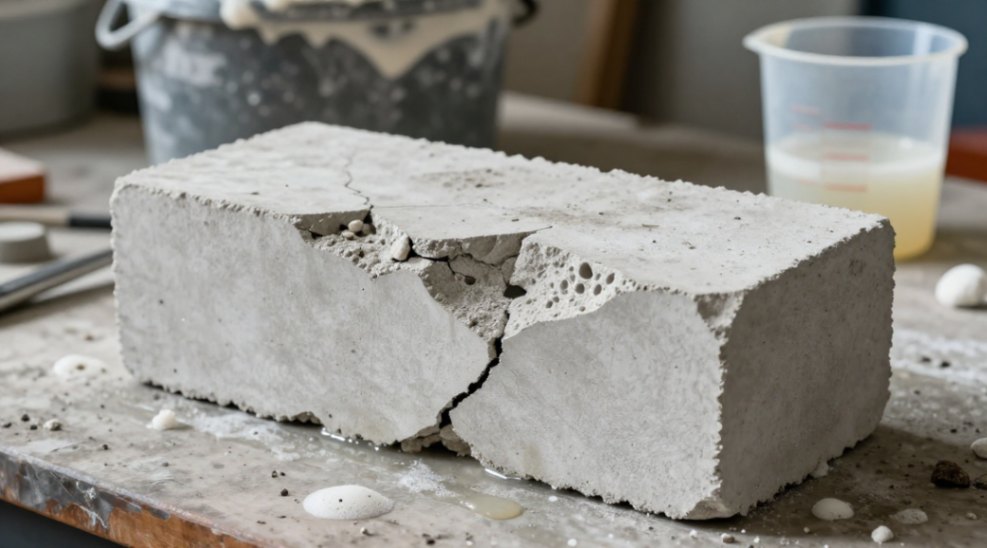
1. Understanding the Core Job of a Concrete Foaming Agent
A Concrete Foaming Agent is not just soap. It is a carefully formulated surfactant that reduces the surface tension of water. When combined with a Foam Generator and compressed air, it creates millions of tiny, stable air bubbles. These bubbles then become a permanent part of the Foamed Concrete matrix. The result? A Light weight Concrete that can be up to 80% lighter than standard concrete. This is not magic. It is applied chemistry. The stability of that foam, from the generator to the final set, determines the success of your project.
2. The Two Main Types: Synthetic vs. Protein Based Foaming Agents
This is the first big fork in the road. Your choice here affects everything from pumpability to final cost. Let’s break down the pros and cons of each.
Synthetic Foaming Agents
- Pros: Excellent for high-volume pours. They are very cost-effective and produce a consistent, fine bubble structure. They mix easily with water and are compatible with common Concrete Water Reducer and Superplasticizer.
- Cons: Lower foam stability compared to protein types. More sensitive to water hardness and mixing speed. If your Foaming Equipment is not calibrated perfectly, you will see bubble collapse.
Protein Based Foaming Agents
- Pros: Superior foam stability. These agents create a tougher, thicker bubble wall. Ideal for low-density foamed concrete (below 600 kg/m³). They hold up better against the pressure of pumping.
- Cons: Higher cost per liter. They have a strong, distinct odor during mixing. They can also interfere with the setting time of some types of Special Cement without a proper Early Strength Agent.
Many users on Reddit recommend synthetics for general backfill and insulation pours. They suggest proteins only when you need that extra stability for very light, high-performance fills.
3. Key Performance Properties You Must Measure
Do not trust marketing claims alone. You need to verify performance before you buy a drum. Focus on these three measurable properties.
- Foam Stability (Drainage Half-Life): This is your number one metric. It measures how long it takes for half of the liquid to drain from the foam. A good agent should give you a drainage half-life of at least 60 minutes. Anything less, and you risk collapse.
- Density Control: Can the agent consistently produce your target density? A high-quality agent allows for precise control with a small adjustment to the dilution ratio. You should be able to hit densities from 300 kg/m³ to 1600 kg/m³ reliably.
- Effect on Compressive Strength: A weak foam creates large, irregular voids that crush easily. A stable foam creates a uniform cellular structure. Test cubes from your mix to ensure your target strength is met.
4. The Five Factors That Kill Your Foam
Even a great agent fails if you ignore these factors. Control these, and your quality will skyrocket.
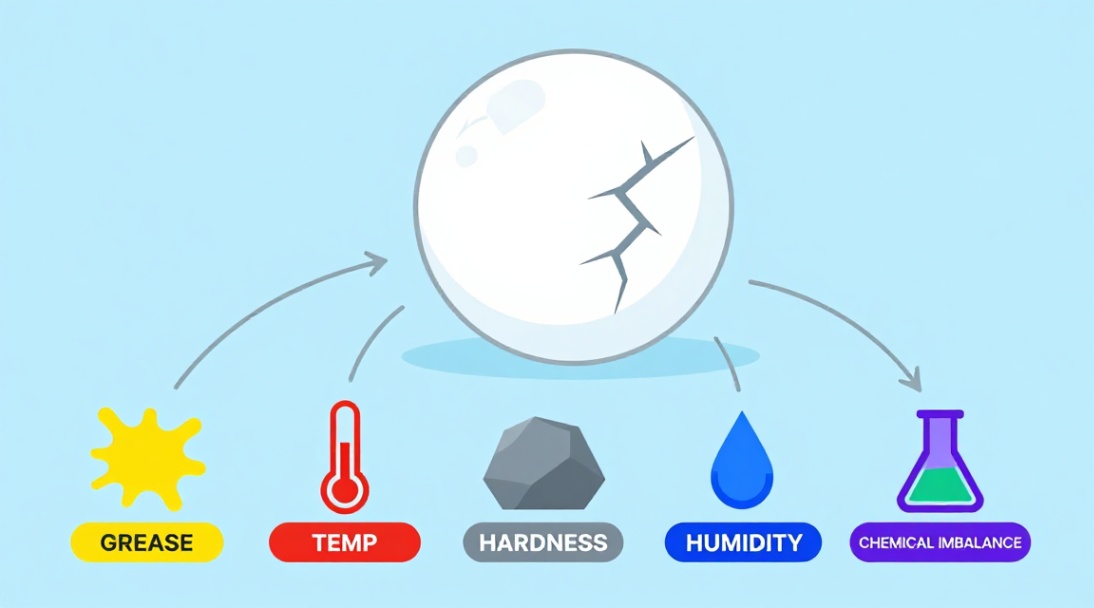
- Water Hardness: Hard water kills synthetic agents. It destabilizes the bubble walls. Use distilled or softened water for your dilution. If you cannot, increase the agent concentration by 10%.
- Dilution Ratio: Follow the manufacturer’s instructions, but treat them as a starting point. A typical ratio is 1:20 to 1:50 (agent to water). Test with your specific water source.
- Mixing Speed and Time: Too slow, and you get big bubbles. Too fast, and you shear the foam into a liquid. Your Foam Generator manual will specify the ideal RPM and pressure. Stick to it.
- Contamination: Oil, grease, or residues from a Concrete Release Agent in your mixer will instantly pop your foam. Clean everything thoroughly.
- Incorrect Additive Use: Too much Concrete Defoamer or an incompatible Redispersible Polymer Powder can destroy the bubble structure.
5. Concrete Foaming Agent vs. Other Lightweight Methods
Foamed concrete is just one option. Here is how it stacks up against the competition.
- Foamed Concrete (this method): Lower cost, excellent thermal insulation, pumpable long distances. Perfect for trench backfill and floor screeds.
- Lightweight Aggregates (e.g., expanded clay): Higher compressive strength. But heavier than foamcrete. More expensive and harder to pump. Good for structural slabs.
- No-Fines Concrete: Easy to make. Very low density. But low strength and high shrinkage. Best for drainage layers, not for thermal insulation.
- Aerated Autoclaved Concrete (AAC): Very high strength and precision. Factory-made blocks. Not a cast-in-place solution. High energy cost to produce.
For most cast-in-place lightweight, void-filling, and insulation jobs, a Concrete Foaming Agent is the most practical and cost-effective tool.
6. Environmental and Safety Considerations
Modern foaming agents are generally safe, but you need to know what you are working with.
- Non-Toxic: Most synthetic and protein agents are non-toxic after mixing. Cured foamed concrete is inert and safe for contact with soil and groundwater.
- Biodegradability: High-quality agents are designed to be biodegradable. Check the data sheet for the supplier’s certification. TRUNNANO products, for example, meet strict environmental standards.
- Low Volatile Organic Compounds (VOCs): You want a low-VOC or zero-VOC product. This prevents air quality issues in enclosed spaces like crawlspaces or basements.
- Handling: Wear gloves and eye protection when handling the undiluted concentrate. Protein agents have a biological smell and can irritate sensitive skin.
7. A Systematic Selection Process for Your Project
Follow this checklist to pick your agent. This removes guesswork and ensures a successful pour.
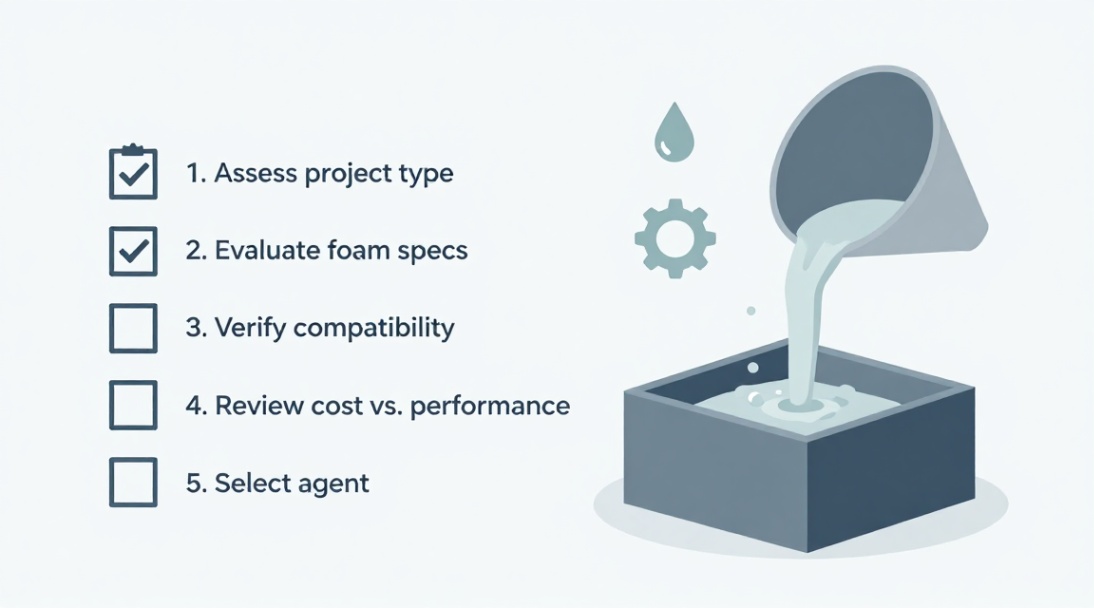
Step 1: Define Your Target Density and Strength
- Density under 600 kg/m³? Go with a Protein Based Foaming Agent. It offers better stability.
- Density above 600 kg/m³? A Synthetic Foaming Agent will perform well and save you money.
Step 2: Check Your Water Source
- Hard water (over 200 ppm)? You need a synthetic agent designed for hard water, or use a protein agent which is more tolerant.
Step 3: Test Your Additive Compatibility
- Are you adding Fiber or Nano-modifier? Make a small test batch. Some fibers can rip bubbles apart. Some Hydroxypropyl Methyl Cellulose (HPMC) or Hydroxyethyl Cellulose (HEC) can actually improve foam stability. Sodium Silicate or Potassium Silicate can accelerate setting, but can also destabilize foam. Test, test, test.
Step 4: Perform a Field Drainage Test
- Mix a small batch of foam exactly as you will on-site. Fill a clear 1-liter cylinder. Time how long it takes for 50 mL of liquid to accumulate at the bottom. This is your drainage half-life. If it is less than 45 minutes, adjust your concentration or switch agents.
Quality Control Table for Foamed Concrete Production
| Parameter | Test Method | Acceptable Range | Action if Out of Range |
|---|---|---|---|
| Foam Density | Weigh 1L of foam | 40 – 80 g/L | Adjust dilution ratio or air pressure |
| Drainage Half-Life | Measure liquid drainage over time | > 45 minutes | Increase agent concentration or change agent type |
| Fresh Foam Concrete Density | Weigh a filled container of known volume | Within 5% of target | Add or subtract foam as needed |
| Compressive Strength (28 days) | Test cubes per ASTM C495 | Matches project spec | Adjust cement content or water-cement ratio |
Your next step is clear. Do not buy blindly. Request a small sample from your supplier. For a reliable, high-quality option, look into products from TRUNNANO. They offer both synthetic and protein-based agents, along with compatible Early Strength Agent and Fiber additives. Test one against your specific water and mixing setup. Your concrete will thank you.
We are the global leader in lightweight concrete and advanced engineered foam solutions. Known globally for its commitment to research, innovation, and applied expertise, we have been providing engineered foam solutions since the early 2012’s.
We can supply high-quality concrete admixture and foam concrete related products all over the world.
The company has a professional technical department and quality supervision department, a well-equipped laboratory, and equipped with advanced testing equipment and after-sales customer service center.
If you are interested, please feel free and contact us.