Professional solutions on concrete addtives, Concrete Foaming Agent, Superplasticizer, CLC Blocks Additives, and foaming machine

Cold Weather Concrete Admixture Guide: Avoid These 5 Critical Mistakes to Prevent Project Failure
A Costly Lesson in the Cold
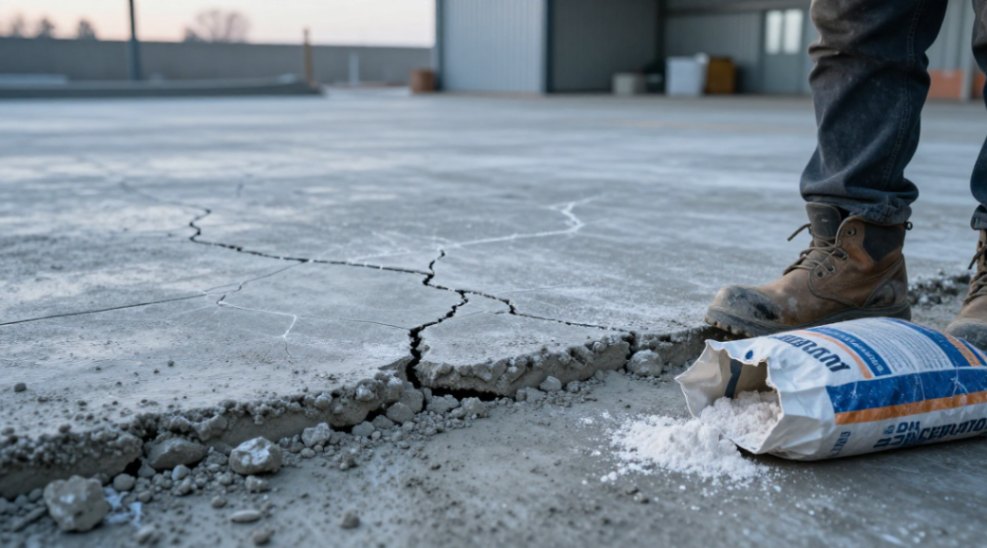
Years ago, a junior project superintendent called me in a panic. His overnight concrete pour for a warehouse slab had turned into a disaster. The surface was soft, crumbly, and marred by cracks. “But we used an accelerator,” he insisted. The investigation revealed the core mistake: they had relied on the early strength concrete admixture for cold weather as a magic bullet, neglecting basic thermal protection. The concrete froze before it gained strength. The result was a $50,000 repair and a three-week delay. This story is not unique. It highlights a critical industry truth: chemical admixtures are powerful tools, but misuse them, and you will fail.
Why Cold Weather Demands a Specialized Approach
Concrete curing is a chemical reaction called hydration. Cold temperatures dramatically slow this reaction. At temperatures near freezing, the process can virtually stop. Concrete must reach a critical compressive strength, typically 500 psi (3.5 MPa), before it can resist permanent damage from a single freezing cycle. If water inside the concrete matrix freezes and expands before this strength is achieved, the paste structure is irreversibly damaged. The concrete will never reach its potential strength or durability. This is the fundamental challenge.
An early strength concrete admixture for cold weather addresses this by accelerating the rate of initial hydration. It gives concrete a fighting chance to achieve that critical 500 psi threshold before temperature drops become a threat. The goal is not just speed, but crisis prevention.
The 5 Most Dangerous Mistakes with Cold Weather Admixtures
1. Treating the Admixture as a Substitute for Protection
This is the cardinal sin. No accelerator can prevent fresh concrete from freezing if left exposed. The admixture buys you time; it does not create a thermal blanket. You must still follow established cold weather concreting practices: use insulating blankets, heated enclosures, or thermal mass. The admixture and protection work in tandem. Relying on the chemical alone guarantees failure.
2. Using Chloride-Based Accelerators in Reinforced Concrete
Calcium chloride is a highly effective and inexpensive accelerator. It is also a primary source of chloride ions, which initiate and accelerate the corrosion of embedded steel reinforcement. This is a catastrophic long-term risk. For any concrete containing steel, you must specify non-chloride accelerators (NCAs). Common NCA chemistries are based on calcium nitrite, nitrates, or thiocyanates. The rule is simple: if there is metal in the concrete, never use calcium chloride.
3. Guessing the Dosage
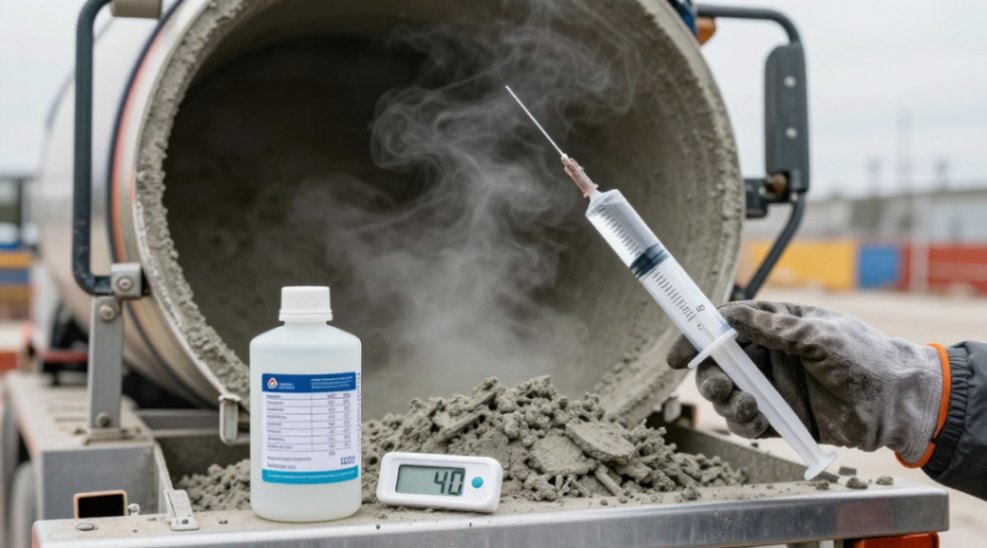
More is not better. Overdosing an accelerator can cause flash set, creating a stiff, unworkable mix right in the truck drum. It generates excessive early heat, leading to thermal stress cracks. It can also compromise the concrete’s ultimate 28-day strength. Admixture dosage is highly temperature-dependent. A dosage effective at 40°F may be excessive at 50°F. Always follow the manufacturer’s guidelines based on the ambient and concrete temperature.
4. Ignoring Compatibility with Other Admixtures
Cold weather concrete often requires an air-entraining agent for freeze-thaw durability. The interaction between accelerators and air-entraining agents is not always predictable. Some accelerator chemistries can reduce air content or destabilize the carefully engineered air-void system. The only way to be certain is to perform trial batches at the project temperature. Never assume compatibility.
5. Believing Admixtures Replace Good Mix Design
You cannot fix a poor mix with an admixture. If the concrete has a high water-cement ratio, inadequate cement content, or marginal aggregates, an accelerator will only help poor concrete fail faster. The foundation is a well-designed, low-slump mix with a moderate cement content. The early strength concrete admixture for cold weather then optimizes this strong foundation.
Implementing a Safe and Effective Strategy
Success comes from a systems approach. Start with a sound mix design. Select the correct accelerator type based on project temperature and the presence of reinforcement. Determine the precise dosage for the expected conditions. Integrate the admixture into a comprehensive protection plan that includes heating mixing water/aggregates, using enclosures, and applying insulation. Monitor in-place concrete temperature continuously.
Selecting the Right Tool for Your Project
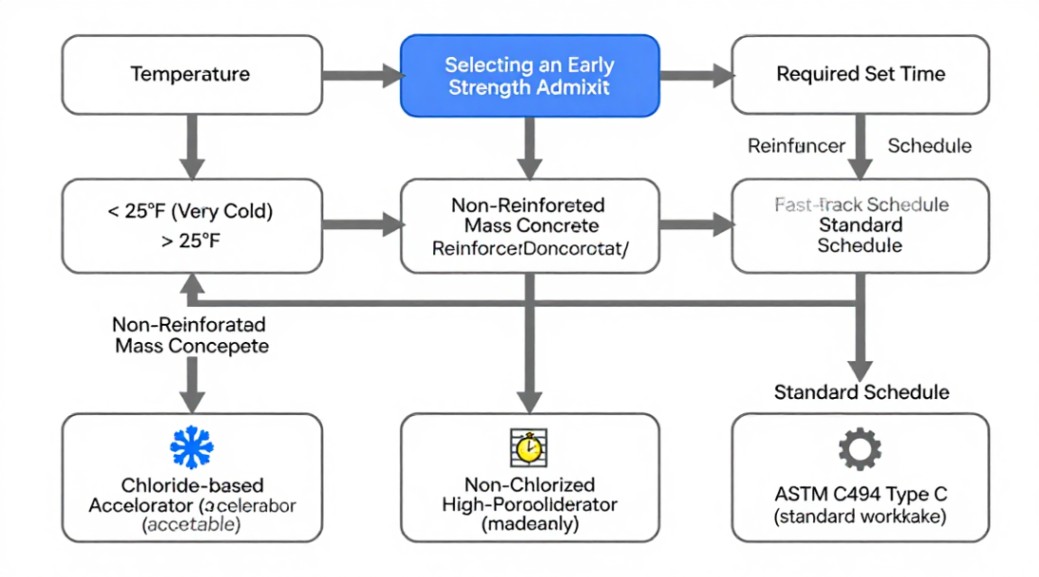
The correct early strength admixture depends on three factors: temperature, reinforcement, and required set time. For non-reinforced mass concrete in very cold conditions (below 25°F), a chloride-based accelerator may be acceptable. For all reinforced concrete, a non-chloride type is mandatory. For extremely fast track schedules where formwork must be stripped in hours, specialized high-performance accelerators are available. For most general winter construction, a mid-range, ASTM C494 Type C (accelerating) admixture is the standard workhorse. Consulting with a qualified technical representative is a prudent step.
The Path to a Successful Pour
Winter concreting is unforgiving. Admixtures like our cold weather early strength accelerator are engineered to de-risk the process, but they are not a standalone solution. They are one critical component within a disciplined, well-planned strategy. The next step is to move from awareness to specification. Review your upcoming cold-weather project specifications. Ensure they mandate non-chloride accelerators for reinforced work. Discuss a full cold-weather protection plan with your ready-mix supplier and site team. Finally, execute with vigilance. The difference between a successful project and a costly failure lies in the details you now understand.
We are the global leader in lightweight concrete and advanced engineered foam solutions. Known globally for its commitment to research, innovation, and applied expertise, we have been providing engineered foam solutions since the early 2012’s.
We can supply high-quality concrete admixture and foam concrete related products all over the world.
The company has a professional technical department and quality supervision department, a well-equipped laboratory, and equipped with advanced testing equipment and after-sales customer service center.
If you are interested, please feel free and contact us.