Professional solutions on concrete addtives, Concrete Foaming Agent, Superplasticizer, CLC Blocks Additives, and foaming machine

7 Marine Concrete Mistakes You’re Probably Making (And Why ‘Sulfate Resistant’ Alone Fails)
The Pier That Crumpled in Three Years
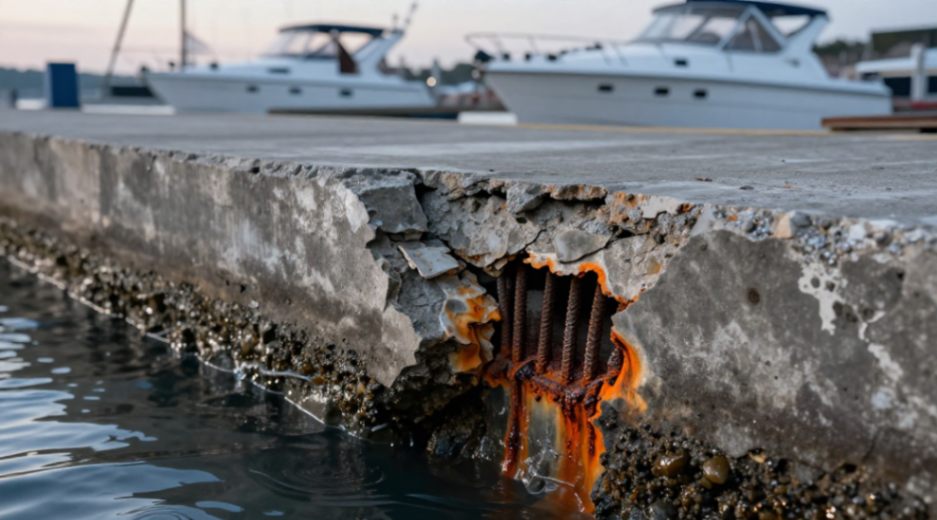
I watched a multi-million-dollar marina pier fail. Not in fifty years. In three. The client used a “premium” sulfate resistant cement. They followed the generic spec. Yet, the concrete spalled, the rebar corroded, and the structure became a liability. The problem wasn’t the cement’s label. It was a lethal cocktail of arrogance, overlooked physics, and a fundamental misunderstanding of what “resistance” truly means in the brutal, wet-dry cycle of the marine zone. If you think specifying sulfate resistant cement for marine environments is your primary defense, you’re already on the back foot. Here are the mistakes you cannot afford to make.
1. Believing “Sulfate Resistant” is a Force Field
This is the foundational error. Sulfate resistant cement (Type V per ASTM C150) has a low C3A (tricalcium aluminate) content. This minimizes the formation of expansive ettringite during sulfate attack. It’s a necessary condition, but far from sufficient. In marine environments, you face a simultaneous, multi-pronged assault:
- Chloride Ingress: This is the true killer. Chlorides penetrate concrete, depassivate the steel rebar, and initiate corrosion. The resulting rust occupies more volume than steel, creating immense internal pressure that cracks the concrete from the inside out. Type V cement does little to stop this.
- Physical Salt Crystallization: Seawater evaporates at the splash zone, leaving salt crystals behind. These crystals grow in pores, generating stress akin to frost action, causing surface scaling and deterioration.
- Wet-Dry Cycling: The tidal zone subjects concrete to constant saturation and drying, accelerating all transport mechanisms for chlorides and sulfates.
The Fix: View sulfate resistant cement as one component of a system. Its job is to handle the sulfate load. You need additional measures—a low water-cement ratio (0.40 max), proper air entrainment, and adequate concrete cover over rebar—to handle chlorides and physical stress.
2. Ignoring the Water-Cement Ratio Law
You can use the best cement on earth. If your water-cement ratio is too high, you’ve built a sponge, not a barrier. Porosity dictates durability. A high w/c ratio creates a network of interconnected capillaries that invite seawater, chlorides, and sulfates deep into the concrete matrix.
I’ve seen specs call for Type V cement with a w/c ratio of 0.50. This is worse than using ordinary Portland cement at 0.40. The permeability of the concrete will govern the rate of attack, rendering the special cement nearly useless.
The Fix: This is non-negotiable. For any marine exposure, especially tidal and splash zones, the water-cement ratio must not exceed 0.40. This requires high-range water reducers (superplasticizers). Your mix design is more critical than your cement type.
3. Neglecting Proper Curing (The Silent Assassin)
Pouring the perfect mix is only half the battle. Improper curing creates a weak, permeable surface layer that betrays the dense interior. In marine environments, this surface layer is the front line. If it’s compromised, the enemy breaches the walls immediately.
- Mistake: Curing for 3 days in a controlled yard, then barging the element to site. The early-age concrete is still vulnerable.
- Mistake: Using curing compounds that are not compatible with marine conditions or future coatings.
- Mistake: Allowing the concrete to dry out or overheat in its first week.
The Fix: Curing must be continuous and rigorous for a minimum of 7 days using water-saturated burlap or impervious sheets. The goal is to prevent moisture loss, allowing the cement to fully hydrate and create a dense, low-permeability microstructure. This step costs pennies but saves millions in service life.
4. Forgetting About Secondary Lines of Defense
Cement and w/c ratio are your primary material defense. In severe exposures (e.g., piles in aggressive currents, Arctic marine conditions), they are not enough. You need engineered backups.
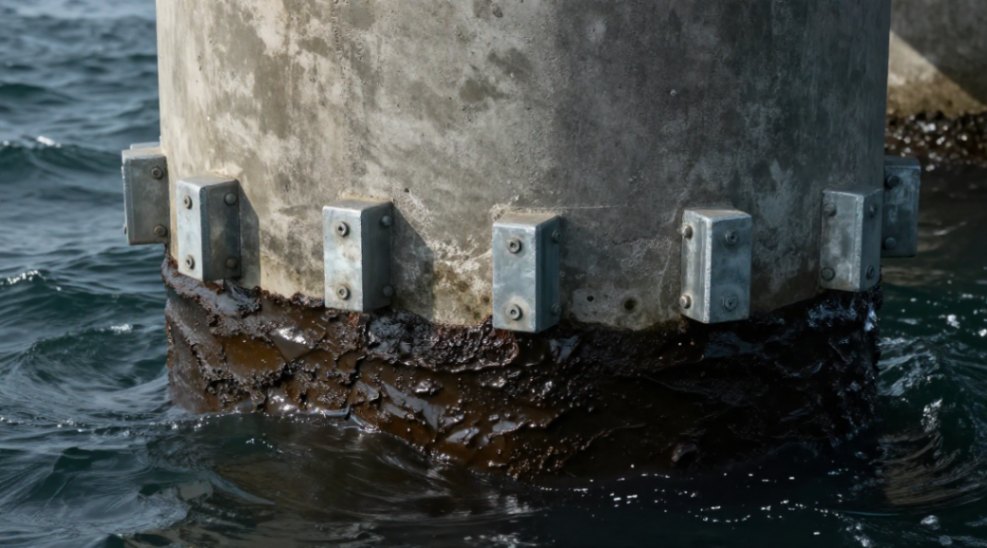
- Supplementary Cementitious Materials (SCMs): Replace 20-30% of the cement with Fly Ash or Slag. These materials create a denser paste, refine the pore structure, and chemically bind chlorides. They significantly enhance long-term durability.
- Corrosion-Inhibiting Admixtures: These are a chemical insurance policy. They raise the chloride threshold needed to initiate corrosion, buying decades of time.
- Migratory Corrosion Inhibitors: Applied to the surface post-construction, they can diffuse through the concrete to protect the rebar, a useful strategy for remediation or extra protection in splash zones.
5. Assuming Placement is Just Another Pour
Marine concrete placement is a surgical operation. Poor consolidation around congested rebar in seawalls or piles creates honeycombs and voids—direct pipelines for seawater to reach the steel. Cold joints from interrupted pours become predetermined failure planes.
The Fix: Use self-consolidating concrete (SCC) mixes for complex forms. Plan pours meticulously to avoid cold joints. Employ experienced placers and finishers who understand that surface troweling must not trap water or laitance (a weak layer of cement and fines), which will later scale off.
6. Overlooking the Real-World Feedback Loop
Theory meets reality on Reddit forums and project post-mortems. The chatter from engineers in the field is telling. One user on a civil engineering subreddit lamented, “We used Type V and still got spalling at the tidal zone. The consultant never mentioned we needed a hydrophobic pore blocker.” Another cited a case where “differential shrinkage between the sulfate-resistant core and a non-compatible repair mortar led to de-bonding in less than a year.”
This feedback underscores a key point: material compatibility and whole-system thinking are everything. Your sulfate resistant cement must work in harmony with your admixtures, your SCMs, and any future repair materials.
7. Skipping the Lifecycle Cost Analysis
This is the executive mistake. Specifying ordinary Portland cement to save $15 per cubic meter is a catastrophic false economy. The total cost of a marine structure is dominated by maintenance, repairs, and potential early replacement.
A durable system using sulfate resistant cement, SCMs, a low w/c ratio, and proper curing might add 20% to initial material costs. It can triple or quadruple
The Path Forward: A Systems Approach
Stop viewing sulfate resistant cement as a singular solution. It is the foundational element of a durability system. Your specification must be a package:
- ASTM C150 Type V cement (or equivalent low-C3A cement).
- Water-cement ratio ≤ 0.40.
- Minimum 7-day wet curing.
- Consideration for 20-25% Fly Ash or Slag replacement.
- Adequate concrete cover (often 75mm+ for splash zone).
- Proper placement and consolidation protocols.
For engineers demanding a pre-engineered, performance-guaranteed system that integrates these principles, the conversation starts with advanced mixes like Concrete. This isn’t about buying a product; it’s about adopting a philosophy where every component, from cement chemistry to curing, is optimized for the relentless marine assault. The goal isn’t just to resist. It’s to endure. Start your next marine project with a durability-first design review, not just a materials requisition.
We are the global leader in lightweight concrete and advanced engineered foam solutions. Known globally for its commitment to research, innovation, and applied expertise, we have been providing engineered foam solutions since the early 2012’s.
We can supply high-quality concrete admixture and foam concrete related products all over the world.
The company has a professional technical department and quality supervision department, a well-equipped laboratory, and equipped with advanced testing equipment and after-sales customer service center.
If you are interested, please feel free and contact us.