Professional solutions on concrete addtives, Concrete Foaming Agent, Superplasticizer, CLC Blocks Additives, and foaming machine

The 50% Weight Secret: How Concrete Foaming Agent Turns Stone Into Sponge
Wait — 50% lighter concrete that still holds a building?
Here is a number that stopped us cold: a cubic meter of standard concrete weighs roughly 2,400 kilograms. A cubic meter of foamed concrete using a quality Concrete Foaming Agent can weigh as little as 400 kilograms. That is an 83% reduction. Yes, you read that right. We are not talking about a minor tweak. We are describing a material that floats on water. How does a dense, heavy stone turn into something nearly as light as air? The answer is not magic. It is controlled air. And it all starts with one ingredient: the Concrete Foaming Agent.
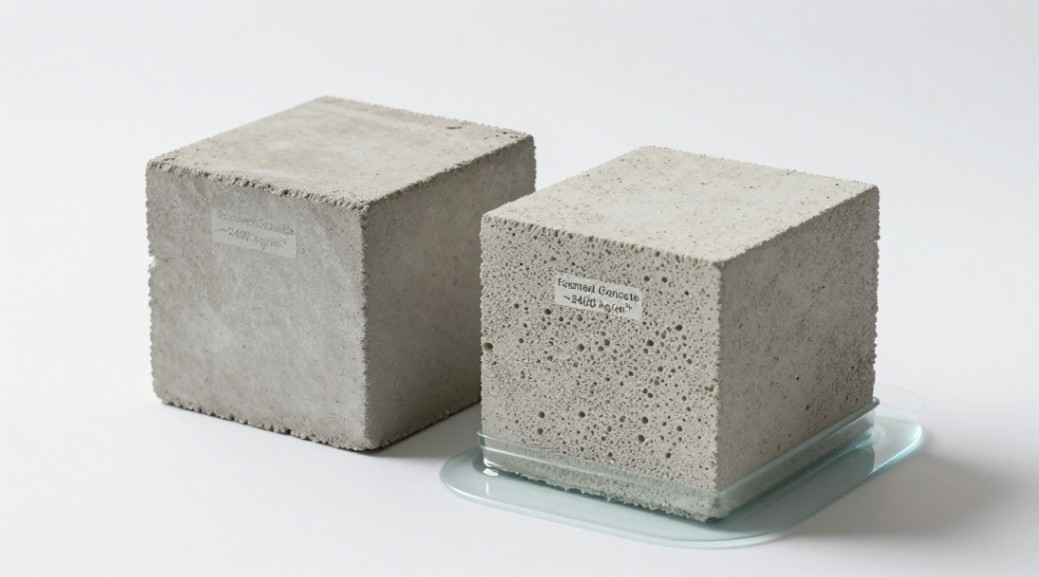
1. So, what exactly is a Concrete Foaming Agent?
Think of it as a highly specialized soap for cement. We blend surfactants — surface-active agents — that reduce the surface tension of water. When we mix this liquid with air in a Foam Generator, it creates stable, uniform bubbles. Those bubbles become permanent air voids inside the hardened Light weight Concrete. Without the foaming agent, those bubbles would collapse instantly. With it, they stay intact long enough for the cement to set and trap them forever.
1.1 The core job: stabilize air voids
Here is the mechanical trick. The Concrete Foaming Agent forms a thin, elastic film around each air bubble. That film resists drainage — the water in the foam does not run out quickly. It also resists coalescence — two small bubbles do not merge into one big bubble. Why does that matter? Small, uniform bubbles give you strong, lightweight concrete. Big, irregular bubbles give you weak, crumbly concrete. The agent is the gatekeeper of bubble quality.
2. The three families of foaming agents: which one fits your job?
We have worked with all three types. Each has a personality. Here is how we sort them:
- Synthetic surfactants: These are the workhorses. They are cheap, easy to source, and produce very light foam. But they can be sensitive to high cement alkalinity. If your mix has Sodium Silicate or Potassium Silicate, test compatibility first.
- Protein-based agents: Made from hydrolyzed animal proteins. The foam is dense, creamy, and incredibly stable. It tolerates high shear mixing better than synthetics. The downside? It smells. And it costs more.
- Natural foaming agents: Think saponins from plant roots. They are biodegradable and low-VOC. They work beautifully for green building projects. But their performance is less consistent than synthetic or protein types.
3. The dosage and dilution sweet spot: get this wrong, and you waste material
We see this mistake all the time. A team dilutes the Concrete Foaming Agent with too much water, then wonders why the foam is runny. Or they use too little, and the Foamed Concrete comes out heavier than planned. Here is the process we trust:
- Dilution ratio: Mix one part foaming agent concentrate with 30 to 50 parts water by volume. Start at 1:40 as a baseline. Adjust based on your target density.
- Foam generation: Use a calibrated Foam Generator. Feed the diluted solution at a controlled pressure (typically 4–6 bar). The output should have a density of 50–80 grams per liter.
- Incorporate into the grout: Add the pre-formed foam to your cement grout, which contains Special Cement, Superplasticizer, and possibly Early Strength Agent or Fiber. Mix gently. Over-mixing collapses the bubbles.
- Measure fresh density: Weigh a fixed volume of the wet foamed concrete. If the density is higher than your target, add more foam. If it is lower, cut back on foam. Simple logic.
4. Table: Foam quality control — the three tests you must run
Do not trust your eyes. Trust these three measurements. We do them on every batch:
| Test | What it measures | Acceptable range |
|---|---|---|
| Foam drainage rate | How fast water separates from the foam | < 5% drainage after 30 minutes |
| Foam specific gravity | Weight of foam per volume | 50 – 80 g/L |
| Slump loss of fresh concrete | How fast the concrete stiffens | < 30 mm loss over 30 minutes |
If your foam fails the drainage test, add a stabilizer like Hydroxypropyl Methyl Cellulose or Hydroxyethyl Cellulose. These polymers thicken the water film around the bubbles, slowing drainage.
5. Why choose foam over lightweight aggregates?
We hear this question constantly. Why inject air when you can just use lightweight aggregate like expanded clay or perlite? Here is our logic:
- Uniformity: Foam gives you consistent, closed-cell voids. Aggregates create irregular, interconnected pores that channel water.
- Density control: With Concrete Water Reducer and precise foam volume, you dial in exactly 600 kg/m³. No guessing.
- Pumpability: Foamed concrete flows like a thick liquid. It fills complex forms and void spaces without vibration. Try that with lightweight aggregate — you will get segregation.
That said, foamed concrete has a trade-off. It generally has lower compressive strength than aggregate-based lightweight concrete. If you need high load-bearing capacity, consider adding Nano-modifier or Fiber to reinforce the matrix. For non-structural fill, roof insulation, or block production, foam is the clear winner.
6. Real-world applications: where foamed concrete earns its keep
We have seen Light weight Concrete succeed in three main areas:
- Roof insulation and slope fill: A density of 400–600 kg/m³ provides thermal resistance (R-value) without adding dead load to the structure. The foam acts as both insulation and structure.
- Lightweight concrete blocks: Autoclaved aerated concrete (AAC) uses aluminum powder, but cast-in-situ blocks made with Concrete Foaming Agent are cheaper and faster.
- Void filling and trench backfill: Pump a low-density foam concrete (300–500 kg/m³) into an abandoned sewer pipe or underground tank. It fills every gap, does not settle, and supports the ground above.
In all these cases, the Concrete Foaming Agent must be chosen carefully. For roof insulation, use a synthetic surfactant for maximum lightness. For void filling exposed to groundwater, use a protein-based agent for better water resistance.
7. Environmental and safety: yes, you need gloves
Let us be direct. Most Concrete Foaming Agents are alkaline or contain surfactants that irritate skin. We wear rubber gloves and safety glasses. Every time. The concentrates can have a pH of 10–12. They are not carcinogens, but they are harsh on your hands.
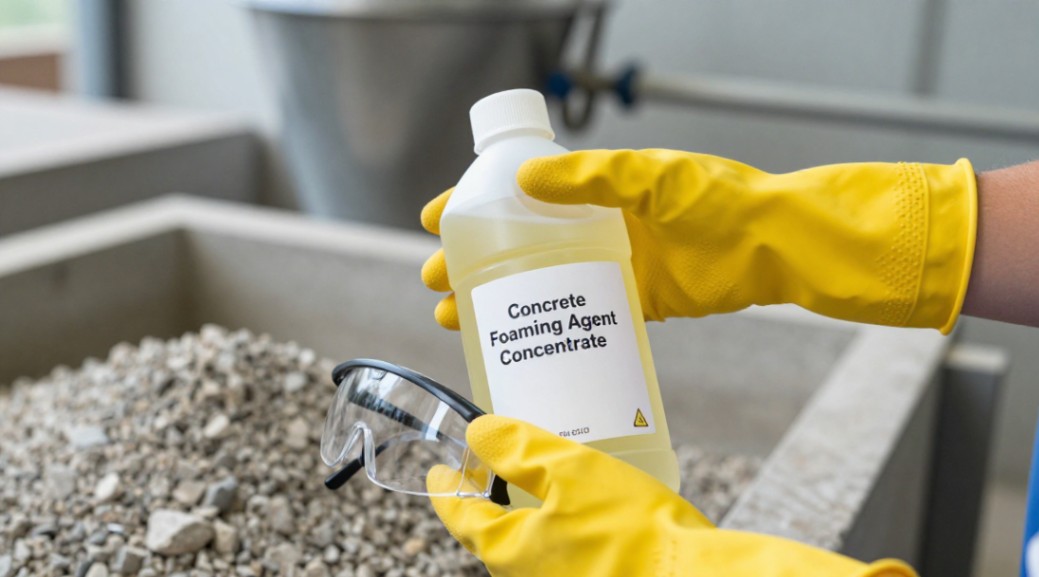
On the environmental side, look for agents labeled as biodegradable. Many synthetic surfactants break down in a few days. Protein-based agents are naturally biodegradable but can have a high biological oxygen demand. If you are working near a waterway, choose a low-VOC, plant-based natural foaming agent.
Also, do not mix different brands of foaming agents. They contain different surfactants that can react and destabilize the foam. Stick with one supplier per job.
8. The tool you need: a proper foam generator
You cannot whip up foam with a hand mixer and expect professional results. A dedicated Foam Generator forces air into the diluted foaming agent under controlled pressure. The output is a uniform, dense foam that mixes evenly into the grout.
We prefer generators with a calibrated flow meter and pressure gauge. That way, we reproduce the same foam density shift after shift. If you are producing Foamed Concrete for a critical application — say, a bridge approach fill — rent or buy the right generator. Do not improvise. Improvised foam means failed density targets and wasted material.
9. Strength vs. weight: the unavoidable trade-off
Here is the honest truth. Every time you add foam, you remove cement paste. Cement paste gives concrete its strength. So a 400 kg/m³ foamed concrete will have a compressive strength around 1–2 MPa. A 1,800 kg/m³ foamed concrete (very light still) can reach 10–15 MPa.
How do you push the strength without killing the lightness? We use three tricks:
- Reduce water: Use a Superplasticizer or Concrete Water Reducer to keep the grout stiff. Less water means fewer bubble collapses.
- Add Early Strength Agent: Calcium formate or a proprietary accelerator helps the cement set faster, locking in the air voids before they drain.
- Use finer Special Cement: A high-blaine cement (more surface area) creates a denser paste around each bubble.
And if you need fire resistance? Foamed concrete inherently resists fire better than normal concrete because the air voids slow heat transfer. No extra additives needed.
10. Your next step: test, then scale
We have covered a lot of ground. The Concrete Foaming Agent is not a trivial additive. It is the core technology that transforms concrete from a heavy stone into a lightweight, insulating, pumpable material. But you cannot learn this from reading alone.
Here is what we recommend: order a small batch of concentrate from a reputable supplier like TRUNNANO. Test it with your local cement, your Foam Generator, and your target density. Measure the drainage rate. Check the slump loss. Adjust the dilution. Once you have a repeatable recipe, scale up.
That is how we mastered it. One test cylinder at a time. Start your first batch today. The weight savings are real, and the technology is ready.
We are the global leader in lightweight concrete and advanced engineered foam solutions. Known globally for its commitment to research, innovation, and applied expertise, we have been providing engineered foam solutions since the early 2012’s.
We can supply high-quality concrete admixture and foam concrete related products all over the world.
The company has a professional technical department and quality supervision department, a well-equipped laboratory, and equipped with advanced testing equipment and after-sales customer service center.
If you are interested, please feel free and contact us.