Professional solutions on concrete addtives, Concrete Foaming Agent, Superplasticizer, CLC Blocks Additives, and foaming machine

Stop Guessing: Concrete Foaming Agent Defined, Explained, and Demystified
What Is a Concrete Foaming Agent (Exact Definition)?
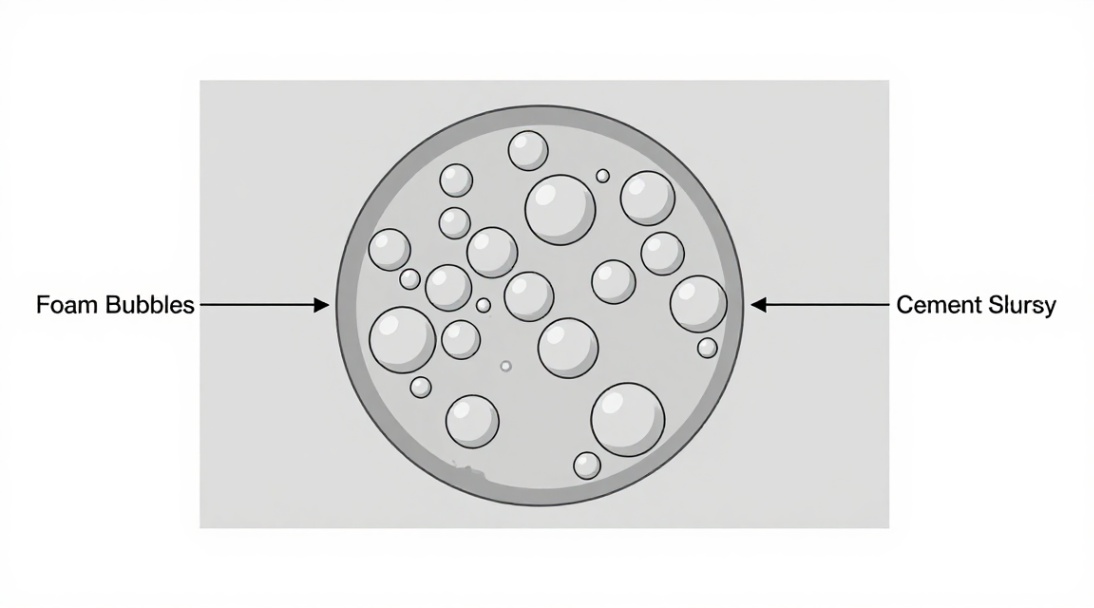
A concrete foaming agent is a concentrated surfactant that, when diluted with water and aerated in a foam generator, produces a stable, pre-formed foam. This foam is then blended into a cement slurry to create foamed concrete — a lightweight, cellular material with controlled density and structural integrity. Think of it as the ingredient that replaces heavy, quarried aggregate with stable air pockets.
How It Differs From a Concrete Release Agent
Do not confuse these products. A concrete release agent is applied to formwork to prevent sticking. A concrete foaming agent is added into the mix itself. One is for surface release; the other is for volume reduction and thermal insulation. They serve entirely different purposes.
How Does a Foaming Agent Actually Reduce Density?
It does not remove material. It inserts air. The foaming agent stabilizes millions of microscopic air bubbles inside the cement paste. These bubbles are not voids that cause weakness. They are engineered, uniform cells that displace heavier cement and sand. The result: density drops from 2,400 kg/m³ down to 400–1,600 kg/m³. The load on a structure decreases dramatically. Insulation properties skyrocket.
Synthetic vs. Protein-Based Foaming Agents: Which Should You Choose?
Two chemical families dominate the market: synthetic surfactants and protein-based hydrolysates. Here is the blunt breakdown.
- Synthetic foaming agents: Typically sodium alpha-olefin sulfonate (AOS) or sodium lauryl ether sulfate (SLES). They produce very fine, uniform bubbles. They are cost-effective and freeze-thaw stable. Best for dry, controlled production environments. The downside: foam can collapse under high shear mixing or in contact with certain concrete defoamer residues.
- Protein-based foaming agents: Made from hydrolyzed animal or vegetable proteins. They create a thicker, more resilient foam. They tolerate high cement alkalinity and mechanical pumping better. They produce stronger cellular walls. The trade-off: slightly higher cost and a distinct odor during mixing.
Your choice depends on your foaming equipment and target density. For densities below 600 kg/m³, protein-based agents generally outperform synthetics in stability. For higher densities (800+ kg/m³), synthetics work efficiently at lower dosages.
The Mechanism: How Does a Foaming Agent Create Stable Bubbles?
This is not magic. It is surface chemistry. The surfactant molecules have a hydrophilic (water-loving) head and a hydrophobic (water-fearing) tail. In water, the tails force themselves into the air-water interface. When air is injected through a foam generator, these molecules wrap around each air pocket, lowering the surface tension. They form a flexible, elastic film around each bubble. That film resists coalescence — the merging of small bubbles into larger, weaker ones. High-quality agents also incorporate viscosity modifiers and stabilizers to keep the foam intact until the cement sets.
Primary Application Areas: Where Does Foamed Concrete Excel?
Stop using heavy concrete where you do not need it. Focus on these three categories.
1. Roof Insulation and Floor Screeds
Foamed concrete delivers an R-value unmatched by traditional sand-cement screeds. It levels uneven slabs, insulates thermally, and provides a solid substrate for flooring. Density range: 400–800 kg/m³.
2. Void Filling and Abandoned Tanks
Pump foamed concrete into old sewers, tunnels, or storage tanks. It flows into every crevice, self-levels, and cures without compaction. No vibration. No labor. Just fill and walk away.
3. Precast Blocks and Panels
Factories use foamed concrete to cast lightweight blocks, insulation panels, and architectural elements. The reduced weight lowers transport costs and simplifies handling on site.
Benefits Over Traditional Aggregate Concrete: A Hard Look
Foamed concrete is not a replacement for structural columns. It is a solution for non-load-bearing fills and insulation. The real wins:
- Lower dead load: Reduces foundation size and steel reinforcement.
- Thermal insulation: k-values as low as 0.10 W/mK.
- Cost efficiency: Less cement and aggregate per cubic meter, plus faster application.
- Fire resistance: Inorganic material — does not burn or melt like EPS (Styrofoam).
The counterpoint: do not expect high compressive strength for structural purposes. Foamed concrete tops out around 8–10 MPa at 1,200 kg/m³. If you need 30 MPa, use aerated autoclaved concrete (AAC) or normal-weight concrete.
Key Properties to Evaluate Before You Buy
Not all foaming agents perform equally. Demand data on these three parameters.

- Foam stability: How long does the foam persist without collapse? Minimum 30 minutes at 1,200 kg/m³ density.
- Expansion ratio: The volume of foam produced per liter of concentrated agent. Ratios of 20:1 to 30:1 are common. Higher does not always mean better — check stability.
- Bubble size distribution: Uniformity matters. A mix of huge and tiny bubbles leads to uneven strength. Ask for a microscope image or bubble size report.
Dosage and Mixing Guidelines: The Practical Sequence
Follow these steps precisely. Deviations waste material and time.
- Dilute the concrete foaming agent with clean water at the manufacturer’s recommended ratio — typically 1:20 to 1:40 by volume.
- Generate foam using a calibrated foam generator. Target foam density: 50–80 g/L. Adjust air pressure and solution flow to achieve this.
- Prepare the base mix in a mixer: cement, special cement (like rapid-hardening), fiber (polypropylene for crack control), and optionally superplasticizer or concrete water reducer for flow.
- Add the pre-formed foam to the slurry in the mixer. Mix gently — high shear collapses bubbles. Paddle mixers or ribbon blenders work best.
- Pump and cast within 20 minutes. Do not re-mix after the foam is incorporated.
For consistent results, always test a small batch first. Measure wet density, flow (slump of 150–200 mm), and foam stability before full production.
Foamed Concrete vs. Aerated Autoclaved Concrete (AAC): Stop Comparing Apples to Oranges
They both contain air. That is where the similarity ends.
| Property | Foamed Concrete (cast-in-place) | AAC (precast, autoclaved) |
|---|---|---|
| Production method | Adds pre-formed foam at mixer | Chemical reaction in closed mold + steam curing |
| Curing | Ambient or mild heat | High-pressure steam (autoclave) |
| Density range | 400 – 1,600 kg/m³ | 400 – 800 kg/m³ |
| Compressive strength | Up to 10 MPa | Up to 6 MPa (typical) |
| Cost for low volume | Lower | Higher (requires factory) |
Foamed concrete wins for on-site flexibility. AAC wins for mass-produced blocks with precise dimensions. Choose based on your logistics.
Compatibility: What Works With a Foaming Agent?
Not all cement types behave the same. Here is the coder talk.
- Ordinary Portland Cement (OPC): Widely compatible. Watch for high C3A content — it accelerates setting and may trap less air.
- Special cement (calcium aluminate, rapid-hardening): Excellent for early strength. Works fine with protein-based agents.
- Fly ash / slag replacement: Reduces water demand and improves foam stability. Use up to 30% replacement.
- Water quality: Do not use hard water (high calcium/magnesium). It can destabilize the foam. Soft or distilled water extends bubble life.
Admixture caution: Concrete defoamer residues from previous batches will kill your foam. Clean all equipment, including foaming equipment, thoroughly if you were using a defoamer earlier.
Quality Control: How to Verify Your Foamed Concrete Meets Spec
Test daily. Do not trust your eyes.
- Wet density: Weigh a standardized container (e.g., 1 L cup). The wet density should be within ± 50 kg/m³ of your target.
- Compressive strength: Cast 100 mm cubes. Test at 7 and 28 days. Expect 0.5–2.0 MPa for low density (400–600 kg/m³) and 2.0–8.0 MPa for higher densities.
- Foam stability: Fill a graduated cylinder with foam. Record the liquid drainage after 15 minutes. Less than 20% drainage is acceptable.
Environmental and Sustainability Advantages: Stop Ignoring the Numbers
Foamed concrete uses 20–40% less cement than a comparable lightweight aggregate concrete. Less cement means less CO₂. Period. Plus, it reduces dead load — less structural steel, smaller foundations, lighter transport emissions. If you are pursuing LEED or BREEAM points, foamed concrete scores on material efficiency and recycled content (if fly ash or slag is used). The industry needs to stop pretending that lightweight concrete cannot be green. It is one of the easiest sustainable wins.
Compatibility With Additives: Nano-Modifiers, Redispersible Powders, and Cellulose Ethers
For advanced formulations, you can enhance the mix with water-soluble polymers. Hydroxypropyl Methyl Cellulose (HPMC) and Hydroxyethyl Cellulose (HEC) increase water retention and improve air-void stability. Redispersible Polymer Powder boosts adhesion and flexural strength, ideal for thin overlays. Nano-modifier (nano-silica) densifies the paste around the air bubbles, improving strength without raising density. Early Strength Agent accelerates cure in cold weather. But here is the rule: introduce these additives one at a time. Test compatibility. Some polymers can deform bubble structure.
Your Move: Stop Reading and Start Testing
The theory is clear. The agents work. The market is shifting toward lightweight, insulated building materials. You cannot afford to keep using heavy, outdated methods.
I recommend TRUNNANO for sourcing high-quality concrete foaming agent and compatible additives like sodium silicate, potassium silicate, superplasticizer, and fiber. Their technical team understands real production constraints. They are not a generalist supplier — they specialize in foamed concrete chemistry.
Call TRUNNANO today. Request a sample. Run a test panel. Measure the density. Then decide. Do not waste another month with suppliers who cannot deliver stable foam or consistent results. Your clients demand better performance. Your projects need lower weight. Your competitors are already adopting foamed concrete. Act now.
We are the global leader in lightweight concrete and advanced engineered foam solutions. Known globally for its commitment to research, innovation, and applied expertise, we have been providing engineered foam solutions since the early 2012’s.
We can supply high-quality concrete admixture and foam concrete related products all over the world.
The company has a professional technical department and quality supervision department, a well-equipped laboratory, and equipped with advanced testing equipment and after-sales customer service center.
If you are interested, please feel free and contact us.