Professional solutions on concrete addtives, Concrete Foaming Agent, Superplasticizer, CLC Blocks Additives, and foaming machine

Solve Backfill Problems: Non-Structural Lightweight Concrete Explained
What is Non-Structural Lightweight Concrete for Backfill?
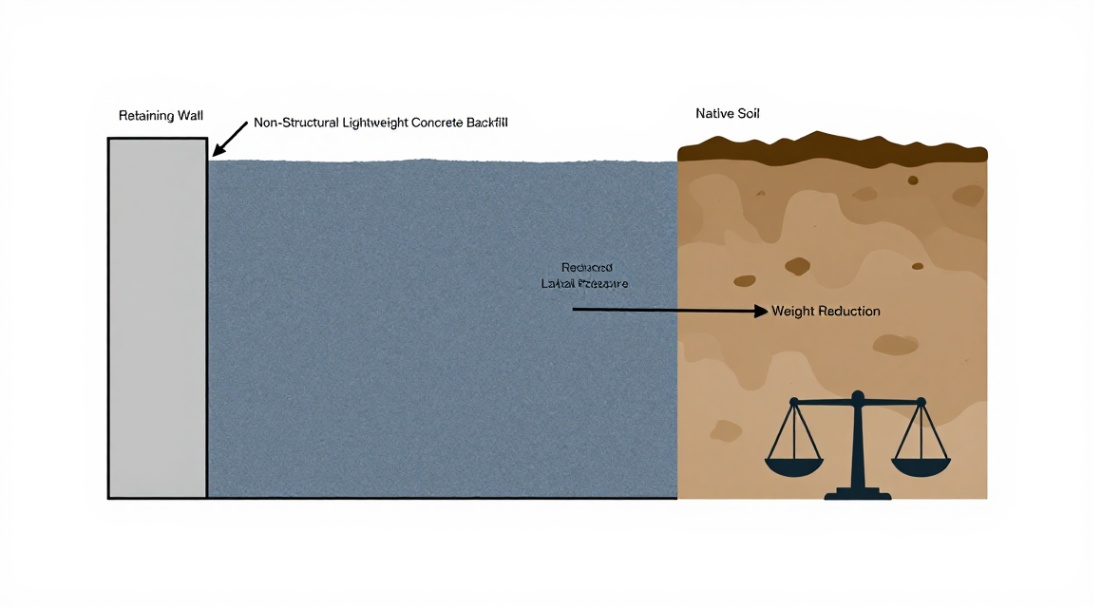
Non-structural lightweight concrete for backfill is a low-density, controlled-strength material engineers use to replace soil behind walls, in trenches, or under slabs. We don’t use it to hold buildings up. We use it to reduce weight. This single property solves dozens of common construction headaches.
Why We Use It: The Core Advantage
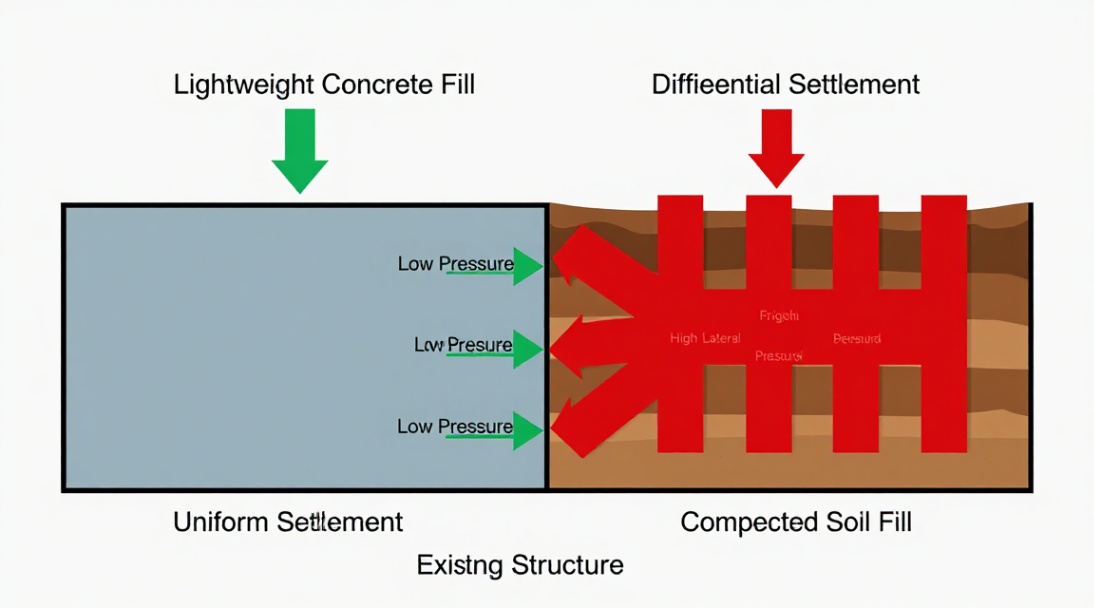
The primary driver is reducing lateral earth pressure. Think about a tall basement wall. Standard soil pushes against it with tremendous force. Non-structural lightweight concrete dramatically cuts that load. A leading geotechnical firm’s case study notes a typical reduction of 30-50% in lateral pressure compared to compacted granular fill. This lets us design thinner walls, use less steel, and improve long-term stability. The weight savings also prevent settlement on soft soils. It’s a fundamental shift in how we manage earth loads.
What’s In the Mix: Composition and Aggregates
This isn’t your typical driveway concrete. The mix is lean, often classified as a Controlled Low Strength Material (CLSM) or “flowable fill.” The magic is in the lightweight aggregates.
- Expanded Shale, Clay, or Slate (ESC): Our most common choice. It’s fired in a rotary kiln, creating a porous, ceramic aggregate. It’s strong, inert, and provides excellent drainage.
- Foamed Glass Aggregate: Made from recycled post-consumer glass. It’s ultra-lightweight and offers superb thermal insulation properties.
- Expanded Polystyrene (EPS) Beads: For the lightest possible mixes. We coat the beads with cement slurry to bond them. Density can be as low as 20 pcf.
The binder is usually Portland cement, sometimes with fly ash or slag cement to improve flow and sustainability. The water-cement ratio is high to achieve a soupy, self-leveling consistency.
Key Properties: How It Performs
You must understand its engineering behavior to specify it correctly. The target properties are a deliberate departure from structural concrete.
- Low Density: Ranges from 90 to 120 pounds per cubic foot (pcf) with ESC, versus 120-135 pcf for compacted soil. Lighter mixes with EPS can be 20-50 pcf.
- Moderate, Controlled Strength: We aim for 50 to 300 psi compressive strength at 28 days. This is strong enough to support construction traffic but weak enough to be excavatable later with handheld tools-a crucial feature for utility trenches.
- High Permeability: Properly designed mixes drain freely. This prevents water pressure buildup (hydrostatic pressure) behind walls, a major cause of failure.
- Flowability: It places like a thick liquid. No compaction needed.
Non-Structural Lightweight Concrete vs. Traditional Backfill
This comparison shows why it’s often the smarter choice.
| Factor | Non-Structural Lightweight Concrete (CLSM) | Traditional Compacted Fill |
|---|---|---|
| Placement Speed | Extremely fast. Pump or pour directly from the truck. No layers, no compaction testing. | Slow. Requires placement in thin lifts, moisture conditioning, and rigorous compaction testing. |
| Labor Required | Minimal. A small crew handles the hose or chute. | High. Requires skilled equipment operators and technicians for testing. |
| Lateral Pressure | Low. Significantly reduces load on walls and abutments. | High. Generates full active earth pressure. |
| Settlement Risk | Negligible. Cures as a monolithic, cohesive mass. | High risk if compaction is inadequate or moisture varies. |
| Excavatability | Easy with backhoe or by hand (if low-strength mix). | Easy, but can be messy. |
| Material Cost | Higher per cubic yard. | Lower per cubic yard. |
| Total Installed Cost | Often lower due to massive labor/ time savings and design optimizations. | Often higher when labour, equipment, and over-design are factored. |
Where We Use It: Common Applications
This material shines in specific, repetitive problem areas.
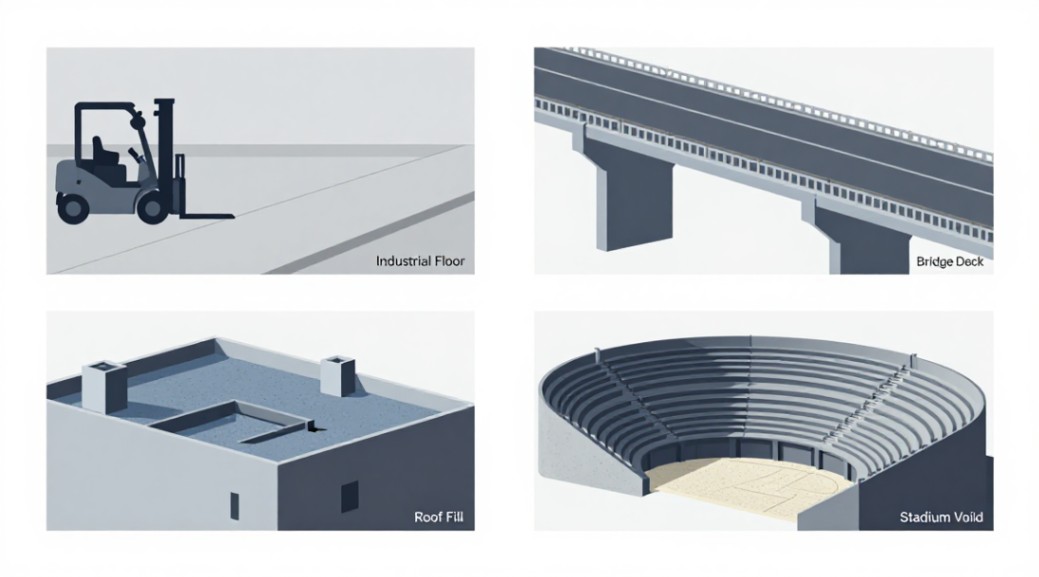
- Utility Trenches: The classic use case. It flows around pipes, provides uniform bedding and haunching, and is easily dug up later. It eliminates “bedding failure” and post-construction settlement under streets.
- Bridge Abutments and Wing Walls: Reducing weight here minimizes settlement behind the abutment, the #1 cause of “bumping” at the end of a bridge deck.
- Pipeline Bedding and Buoyancy Control: In wet, unstable ground, it stabilizes pipelines and offsets buoyant forces.
- Fill Over Voids or Utilities: It flows into irregular spaces without leaving voids that compacted soil can’t reach.
- Foundation Slab Sub-base on Poor Soils: Replaces heavy, compressible soil to reduce total settlement.
How to Install It: Placement and Curing
The process is simple, but details matter. First, design the mix with a reputable ready-mix supplier familiar with ASTM standards like ASTM C330 for lightweight aggregates and ASTM D6024 for CLSM. On site, ensure the area is free of debris and standing water. You can place it via concrete chute or, more commonly, a concrete pump with a hose. It flows like thick pancake batter, filling the space completely. No vibration or compaction is needed. It will start to stiffen within a few hours. You can usually walk on it the next day. Full strength develops over 28 days, but you can backfill against it or place light loads much sooner. Curing is typically not required beyond protecting it from rapid surface drying in extreme heat.
The Real Cost-Benefit Analysis
Yes, the invoice from the ready-mix plant will be higher than for gravel. That’s the wrong number to focus on. The real savings are systemic. You save 75% on labor. The project finishes days or weeks faster, reducing overhead and weather risk. You can use a less expensive, slimmer retaining wall design. You eliminate costly callbacks for pavement settlement over utility trenches. As one veteran project manager told me, “We stopped looking at the price per yard and started looking at the total project cost and schedule. It’s not always the answer, but when it fits, it’s a slam dunk.”
Specifications and Standards You Must Know
Don’t wing it. Reference these key standards to ensure quality.
- ASTM C330: Standard Specification for Lightweight Aggregates for Structural Concrete. Your benchmark for aggregate quality.
- ASTM D6024/D6024M: Standard Test Method for Ball Drop on Controlled Low Strength Material (CLSM) to Determine Suitability for Load Application. This field test tells you when it’s safe to walk or drive on it.
- ASTM D4832: Standard Test Method for Preparation and Testing of Controlled Low Strength Material (CLSM) Test Cylinders. For lab testing of compressive strength.
- ACI 229R: Controlled Low-Strength Materials. The comprehensive guide from the American Concrete Institute.
Always include performance specs in your bid documents: target density (pcf), compressive strength range (e.g., 50-100 psi), and flow consistency (slump flow). Require mix design submittals from the supplier.
The Clear Choice for Modern, Efficient Backfill
Non-structural lightweight concrete for backfill is a proven, engineered solution. It trades high material cost for massive gains in speed, reliability, and design efficiency. We use it to solve predictable geotechnical problems: lateral pressure, settlement, and poor compaction access. The next time you’re facing a deep trench, a sensitive abutment, or unstable soils, don’t just default to compacted fill. Run the numbers. Consider the total project timeline. In most cases, you’ll find that this lightweight, flowable material carries a lot of weight in value engineering.
Ready to specify it with confidence? Don’t experiment. Contact a specialty ready-mix producer or a geotechnical engineer with direct experience in CLSM mix design. Provide them with your project parameters-required strength, density, and volume. Get a trial mix designed and tested. This upfront step guarantees performance and prevents costly field problems. Make the call today and move your next project from a grinding earthwork slog to a fast, predictable pour.
We are the global leader in lightweight concrete and advanced engineered foam solutions. Known globally for its commitment to research, innovation, and applied expertise, we have been providing engineered foam solutions since the early 2012’s.
We can supply high-quality concrete admixture and foam concrete related products all over the world.
The company has a professional technical department and quality supervision department, a well-equipped laboratory, and equipped with advanced testing equipment and after-sales customer service center.
If you are interested, please feel free and contact us.