Professional solutions on concrete addtives, Concrete Foaming Agent, Superplasticizer, CLC Blocks Additives, and foaming machine

The Crucial (and Often Misunderstood) Role of Superplasticizers in Self-Consolidating Concrete
A Story of Flow and Failure
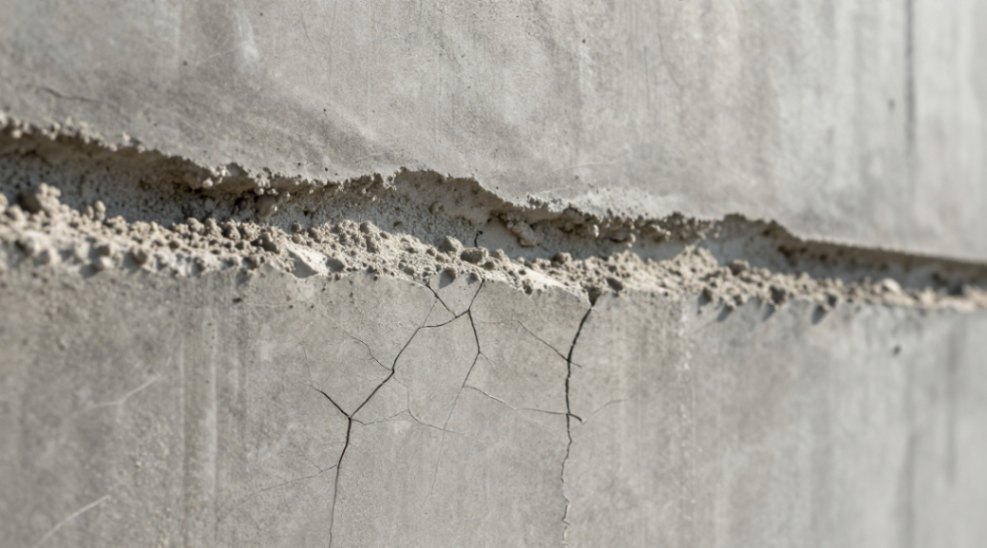
I watched a crew pour a complex architectural wall. The SCC mix looked perfect in the drum-a smooth, flowing grey river. It poured beautifully, filling every corner of the formwork. Then, we waited. The next morning, we stripped the forms. The surface was a disaster. A network of fine cracks, like a dried-up riverbed, covered the face. Segregation had occurred silently. The mix bled water, which rose, carrying fines to the surface, leaving a weak, porous layer beneath. The culprit wasn’t the design. It was a fundamental misunderstanding of the superplasticizer for self-consolidating concrete SCC. The team had treated it like simple water reducer. They added more for extra flow, breaking the delicate balance between fluidity and stability. That wall taught me more about superplasticizers than any textbook. It taught me what not to do.
The Unforgiving Chemistry of Flow
Think of a superplasticizer, specifically a modern Polycarboxylate Ether (PCE), as a precision tool. Its job is not just to make concrete wetter. Its job is to dismantle the natural clumping of cement particles. Cement in water is sticky. It forms flocks that trap water, increasing viscosity and requiring more water for workability. A PCE superplasticizer molecule has a backbone that adsorbs onto the cement particle and long, comb-like chains that extend out into the water. These chains create a powerful steric hindrance-a physical barrier that pushes particles apart. This dispersion releases the trapped water. The mix becomes fluid without adding a single extra drop of water. This is the core mechanism. It reduces water content for higher strength. It enables the high flowability that defines SCC. But this power is conditional.
The Trap of Over-Dosing
Never chase flow by blindly adding more superplasticizer. This is the single most common and catastrophic error. The dispersion effect has limits. Exceed the optimal dosage, and you saturate the system. The powerful repulsive forces can become too strong, destabilizing the entire suspension. Fine particles and cement grains lose their ability to support each other. They begin to separate. Heavier aggregates settle. Water bleeds to the surface. You get segregation, not SCC. The result is a layered, non-homogeneous mass with compromised strength, durability, and a terrible surface finish. The correct dosage is a precise point, determined by rigorous job-site testing with your specific materials, not a guess from a data sheet.
Slump Retention is Not Optional
Imagine your mix passes the slump-flow test at the plant. Perfect. Then it sits in traffic for 45 minutes. Arrives on site. It’s now stiff, unworkable. The crew adds water. They just destroyed the designed water-cement ratio, sacrificing strength and increasing shrinkage. Slump loss is a death sentence for SCC quality. A high-quality PCE superplasticizer for self-consolidating concrete SCC must provide consistent slump retention. The molecules must resist being consumed by early hydration reactions. They must maintain their dispersing power over the required placement window-often 60 to 90 minutes. If your superplasticizer cannot do this, you are not using SCC admixture. You are using a ticking time bomb. Always test for workability retention under realistic time and temperature conditions.
The Silent Incompatibility
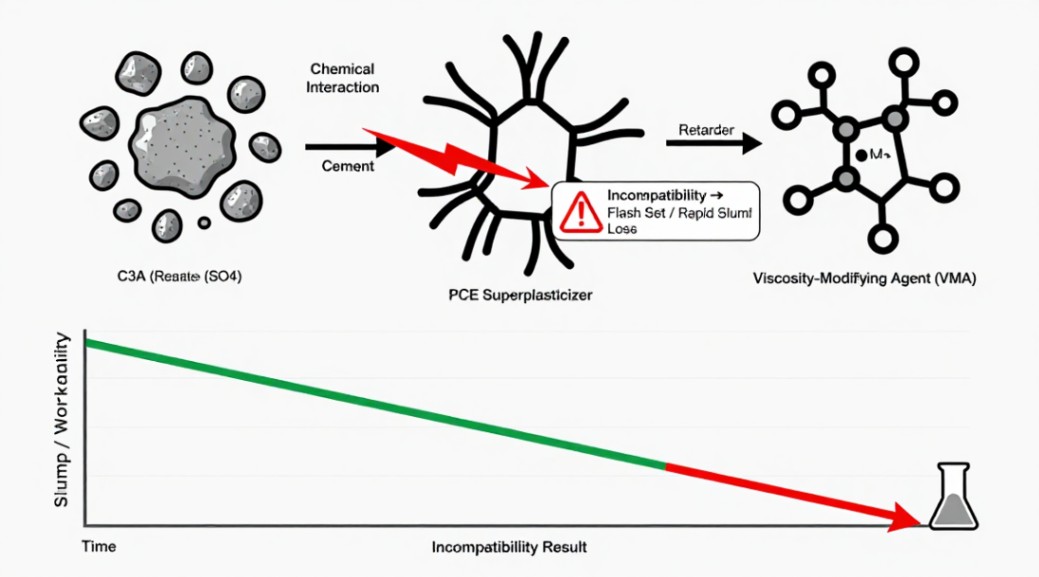
Your superplasticizer is not working in isolation. It interacts with every other component. The cement’s chemistry-its C3A content, sulfate levels-can dramatically alter the superplasticizer’s performance. Some cements cause rapid slump loss. Some require different molecular structures of PCE. Other admixtures, like viscosity-modifying agents (VMAs) or retarders, must be compatible. An incompatible combination can lead to instant flash set or complete loss of cohesion. Never assume compatibility. Always, always conduct pre-construction trial batches with the exact materials you will use on the job. This is non-negotiable. Laboratory results with generic materials are merely a starting point.
A Guide to Avoiding the Pitfalls
So, how do you navigate this? You adopt a disciplined, evidence-based approach. Stop treating the superplasticizer as a magic potion. Treat it as the most sensitive component in your mix design.
- Test with Your Materials. Your sand, your stone, your cement, your local water. Batch a trial mix.
- Find the Saturation Point. Incrementally increase the superplasticizer dosage in small trials. Measure slump flow, T50 time, and visual stability index (VSI). The optimal dose is just before flow increases plateau and stability begins to decline.
- Demand Retention Data. Test the mix after 60 and 90 minutes. It must remain cohesive and fluid without segregation.
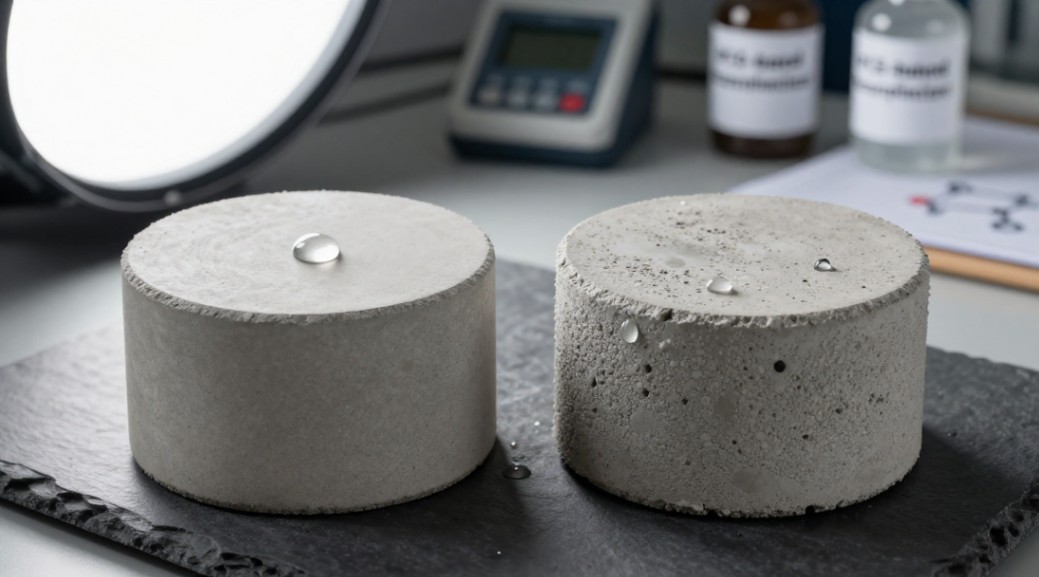
- Evaluate Surface Finish. Cast a small panel. Let it set. Examine it for bleeding, sand streaking, or surface voids. The true test is in the hardened state.
This process reveals the true character of your superplasticizer for self-consolidating concrete SCC. It separates robust, reliable performers from inconsistent products. A superior PCE-based solution will demonstrate a wide dosage window for consistent performance, excellent compatibility, and predictable retention. It provides the control you need to execute complex placements with confidence, ensuring the concrete flows yet remains rock-solid in its homogeneity. The right tool doesn’t create problems; it solves them.
Beyond the Pour
The correct use of a high-performance superplasticizer is a sustainability strategy. By enabling low water-cement ratios at high flowability, it directly contributes to higher ultimate strength and superior durability-less permeability, better resistance to chloride ingress and freeze-thaw. This extends the service life of the structure. It reduces the need for repairs and the associated material consumption. Furthermore, it allows for the use of supplementary cementitious materials like slag or fly ash more effectively, reducing the carbon footprint of the mix. This isn’t just about flow. It’s about building structures that last longer with less environmental impact. Ignoring the nuanced role of the superplasticizer jeopardizes all these benefits. It risks building weak points into your project from day one.
The industry norm is to specify a superplasticizer and hope. The counterintuitive perspective is to treat it as the project’s linchpin. Understand its chemistry. Respect its limits. Test its performance relentlessly with your specific materials. Your concrete’s final performance-its strength, its beauty, its longevity-is decided the moment you choose and dose your superplasticizer. Choose based on evidence, not habit. Your walls, and your reputation, depend on it.
We are the global leader in lightweight concrete and advanced engineered foam solutions. Known globally for its commitment to research, innovation, and applied expertise, we have been providing engineered foam solutions since the early 2012’s.
We can supply high-quality concrete admixture and foam concrete related products all over the world.
The company has a professional technical department and quality supervision department, a well-equipped laboratory, and equipped with advanced testing equipment and after-sales customer service center.
If you are interested, please feel free and contact us.