Professional solutions on concrete addtives, Concrete Foaming Agent, Superplasticizer, CLC Blocks Additives, and foaming machine

Foamed Concrete for Floor Screeding: The Objective Trade-Offs Against Sand-Cement
The core decision between foamed concrete and traditional sand-cement for floor screeding hinges on a single trade-off: you exchange raw compressive strength for unparalleled lightweight, self-leveling, and insulating properties. This choice dictates everything from structural preparation to final floor performance. The following analysis strips away marketing claims to compare the two systems on their fundamental technical merits and practical site realities.
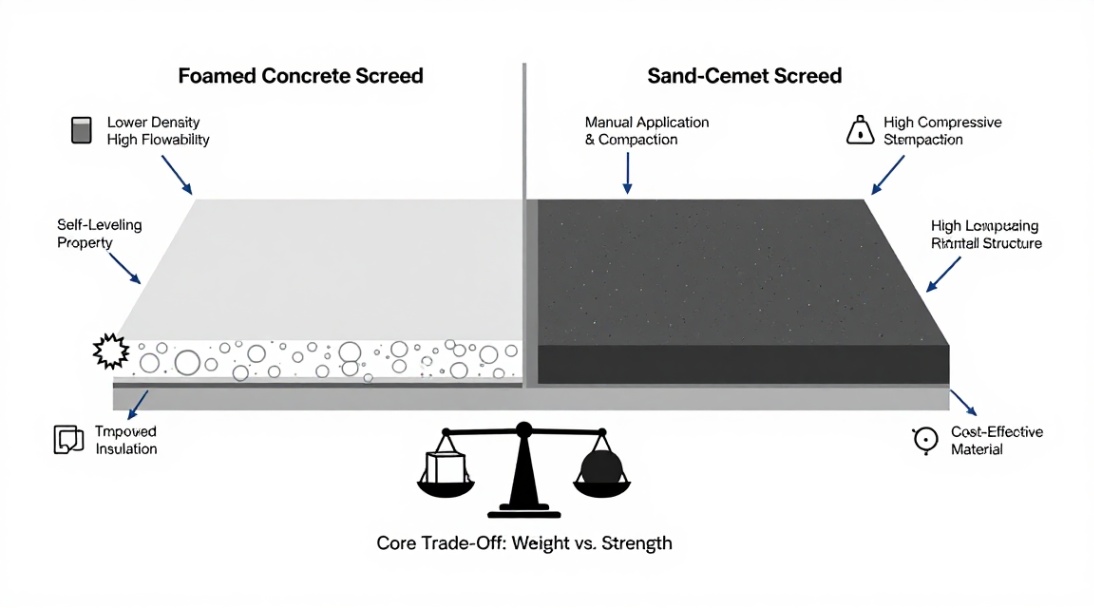
The Material Battle: A Component-by-Component Breakdown
Traditional sand-cement screed is a dense, weight-bearing system. Its composition is straightforward: cement, sharp sand, and water. The mix design focuses on achieving high compressive strength, often above 25 MPa, through a low water-cement ratio and graded aggregates. It is a brute-force solution. Foamed concrete screed operates on a different principle. It is a carefully engineered cellular structure. The base mix is a fluid slurry of cement, fine fly ash or silica fume, and water. A separately generated, stable foam-using a protein or synthetic foaming agent-is then blended into this slurry. The foam generator’s precision controls the target density, which for floor screeding typically ranges from 800 to 1200 kg/m³. This process creates millions of uniform, non-interconnected air voids.
Key Properties Compared: The Inherent Compromise
Consider these properties as a direct, inverse relationship.
- Weight & Load: Foamed concrete wins decisively. At 1000 kg/m³, it imposes roughly half the dead load of a traditional screed. This is its primary advantage for refurbishment projects, over existing slabs, or in high-rise construction where reducing structural load is critical.
- Compressive Strength: Sand-cement wins decisively. A foamed screed mixes for 7-15 MPa strength. It is not a structural element. It is a levelling and insulating layer that must be protected from point loads.
- Flowability & Self-Levelling: Foamed concrete wins. The slurry’s fluidity, enhanced by plasticizers, allows it to flow into complex shapes and around underfloor heating pipes with minimal manual levelling. Traditional screeds require skilled travel work to achieve a flat surface.
- Thermal & Acoustic Insulation: Foamed concrete wins. The entrapped air cells provide significant resistance to heat transfer and dampen impact sound. A sand-cement screed is a thermal bridge and conducts sound readily.
- Drying Times: This is complex. Foamed concrete contains less free water initially but the closed cell structure can slow moisture vapor emission. Traditional screeds have more water to lose. Proper curing and ventilation are non-negotiable for both.
Execution on Site: Where Theories Meet Reality
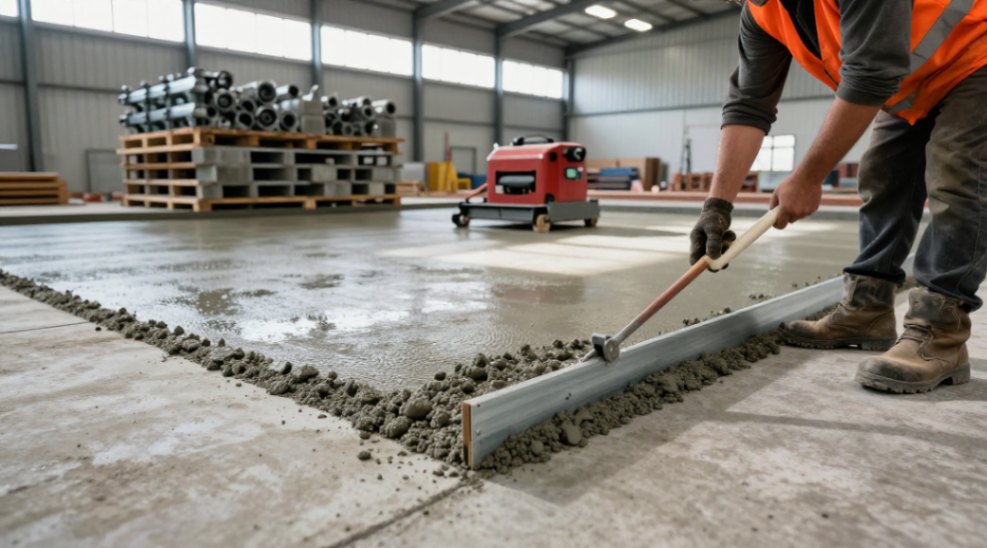
The quality of a foamed concrete screed is only as good as its most fragile component: the foam. Foam collapse during mixing or placement leads to catastrophic density variation and weakness. The water-cement ratio in the base slurry is therefore paramount; excess water destabilizes the foam bubbles. Production must be continuous. You cannot mix a batch, stop for lunch, and then resume. The process demands a trained crew operating the foam generator and pump in unison. Placing is simple-the material flows. Compaction, necessary for sand-cement, is forbidden here as it will destroy the foam matrix. Curing is critical. You must immediately cover the placed screed with polythene sheeting to prevent plastic shrinkage cracking as the surface water evaporates from the porous structure. Traditional screeds are more forgiving of on-site delays and variable mixing but are far more labour-intensive to spread and finish to a true level.
Making the Informed Choice: A Decision Framework
The choice is not about which is ‘better.’ It is about which is correct for your specific project constraints.
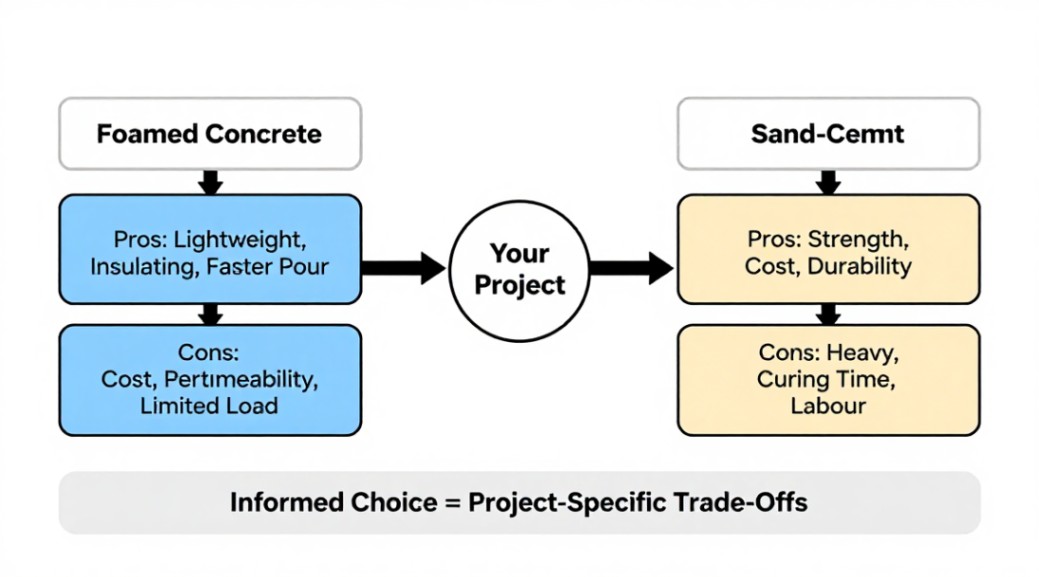
Choose Foamed Concrete Screed when: Your project is a renovation where added load is a concern. You require integrated thermal insulation in the floor build-up. The subfloor is irregular or contains a labyrinth of underfloor heating pipes. You have access to a specialist contractor with verified experience in the material’s precise mixing and placing protocols.
Choose Traditional Sand-Cement Screed when: The application requires high point load resistance, such as in commercial or industrial settings. The budget is highly constrained and specialist equipment is not feasible. The substrate is a ground-bearing slab with no weight restrictions. The construction timeline is unpredictable, requiring the ability to place screed in discontinuous phases.
The modern solution often lies in a hybrid approach. For instance, a precise foamed concrete mix design from a trusted manufacturer can be employed for the bulk of the depth to achieve lightweight and insulation, topped with a thin, high-strength wear layer. This leverages the strengths of both systems. To implement this effectively, you need reliable, consistent foam generation technology and mix designs proven for floor applications, not just generic foamed concrete. This is where partnering with a specialist provider who understands the screeding-specific density and stability requirements becomes a logical step in the process, transforming the theoretical advantages into a flawless, durable floor.
We are the global leader in lightweight concrete and advanced engineered foam solutions. Known globally for its commitment to research, innovation, and applied expertise, we have been providing engineered foam solutions since the early 2012’s.
We can supply high-quality concrete admixture and foam concrete related products all over the world.
The company has a professional technical department and quality supervision department, a well-equipped laboratory, and equipped with advanced testing equipment and after-sales customer service center.
If you are interested, please feel free and contact us.