Professional solutions on concrete addtives, Concrete Foaming Agent, Superplasticizer, CLC Blocks Additives, and foaming machine

Decoding AAC Block Specifications: A Contractor’s Blueprint for Stronger, Faster, Greener Builds
Stop Guessing, Start Building Right with AAC
Have you ever unloaded a pallet of AAC blocks, only to find inconsistent sizes throwing your entire layout out of whack? Have you stressed over thermal performance calculations or wondered if your mortar mix was right? You’re not alone. Misunderstanding aerated autoclaved concrete AAC block specifications leads to delays, callbacks, and compromised builds. This guide cuts through the confusion. We provide the clear, actionable specs you need to build with confidence.
The Core Specifications Every Professional Must Know
Think of these as the non-negotiable rules for AAC success. Getting these wrong undermines everything.
1. The Foundation: Dimensions, Density, and Strength
These three factors dictate everything from structural design to thermal performance. They are interdependent.
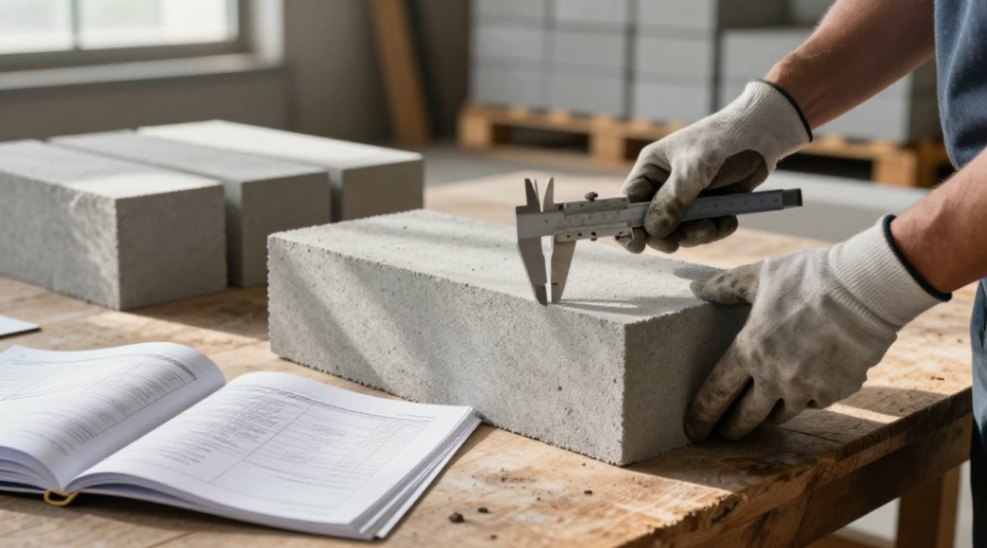
- Dimensions and Tolerance: Standard block length is typically 600mm or 625mm. Height is 200mm or 250mm. Thickness varies from 75mm for partitions to 300mm for load-bearing walls. The critical spec is the tolerance, often as tight as ±1.5mm. Loose tolerances cause thick mortar joints and weak walls.
- Dry Density: This is the weight per cubic meter in a dry state. Common grades are 600 kg/m³, 700 kg/m³, and 800 kg/m³. Lower density means better insulation but slightly less compressive strength. Choose based on your load-bearing and insulation needs.
- Compressive Strength: Ranges from 3 to 5 N/mm² for most blocks. A 600 kg/m³ block typically achieves 3.5 N/mm², while an 800 kg/m³ block reaches 5 N/mm². This strength is more than sufficient for low to mid-rise construction when designed correctly.
2. Performance Specs: Why AAC Outperforms Brick and CLC
This is where AAC earns its reputation. The autoclaving process creates a stable, crystalline structure that clay bricks and air-cured CLC blocks cannot match.
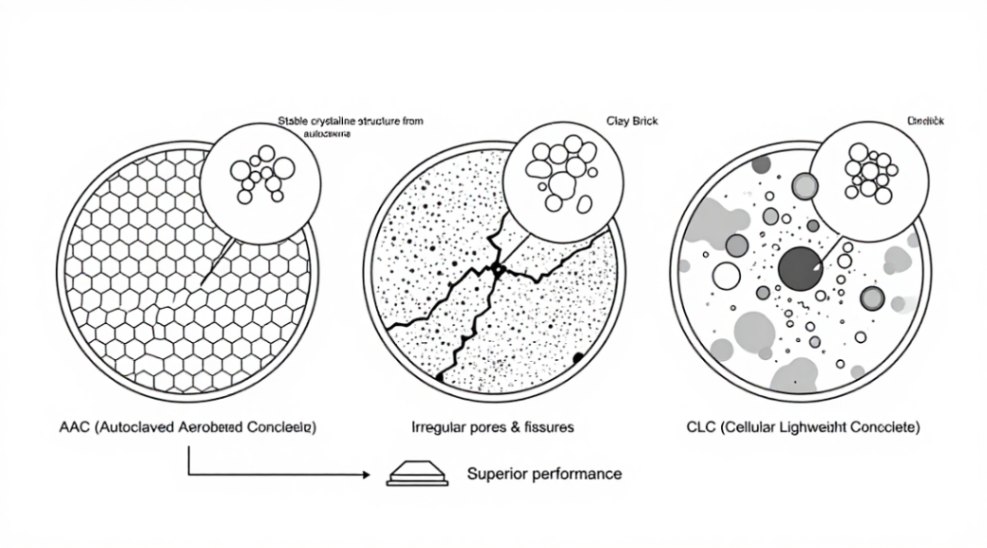
- Thermal Conductivity (k-value): This is AAC’s superstar spec. A 600 kg/m³ block has a k-value around 0.14 W/mK. A traditional clay brick is about 0.8 W/mK. Translation: AAC walls provide up to 5x better insulation. This directly reduces HVAC system size and lifetime energy costs.
- Fire Resistance: AAC is non-combustible. Standard 200mm thick load-bearing walls easily achieve 4-hour fire ratings (REI 240). The material contains no toxic fumes when exposed to fire.
- Moisture Absorption: AAC is hygroscopic but not waterproof. It can absorb water, which reduces its insulating ability until it dries. The specification to note is the capillary rise. Proper exterior plaster or cladding is mandatory in wet climates to manage this.
3. The Installation Rulebook: Mortar, Reinforcement, and Handling
Even perfect blocks fail with poor installation. Follow these protocols.
- Specialized Mortar: Use thin-bed mortar specifically for AAC. Joint thickness should be 2-3mm, not the 10-12mm used for brick. Thick cement-sand mortar creates cold bridges and weak points. The thin joint ensures uniform strength and thermal continuity.
- Reinforcement: All movement joints, lintels, and seismic belts require reinforcement. You place rebar into pre-cut chases in the blocks and fill them with a specialized grout. This creates a monolithic reinforced frame within the wall.
- Handling and Storage: AAC is strong but brittle on the edges. Use nylon slings, not steel cables. Store blocks on flat, level ground under a tarp. Never throw them. Cutting requires a toothed hand saw or diamond-blade power saw-it cuts like wood.
Beyond the Data Sheet: The Smart Builder’s Checklist
Specs on paper are one thing. Real-world application is another. Before you sign off on a delivery, run through this list.
- Visual and Dimensional Check: Reject pallets with significant edge spalling or cracks. Randomly sample 5 blocks from a delivery and measure them. Check for bowing or twisting.
- Verify the Code Compliance: Insist on a mill certificate or test report showing compliance with ASTM C1693 or equivalent EN/ISO standards. This document confirms the density, strength, and dimensional tolerance were tested and passed.
- Plan for the Environment: AAC’s green credentials are a major spec. The material often contains over 70% recycled content (fly ash). Its production energy is roughly 1/3 that of clay brick. Its insulating performance drives the building’s operational energy efficiency down. Specify this to meet green building codes.
- Application Guidance: Use higher density blocks (700-800 kg/m³) for load-bearing walls and foundations. Use lower density blocks (500-600 kg/m³) for non-load-bearing partitions and superior insulation infill. Always consult a structural engineer for load-bearing designs.
Your Path to Flawless AAC Projects
Mastering aerated autoclaved concrete AAC block specifications is not about memorizing numbers. It’s about understanding the why behind them. The tight tolerance ensures speed and plumb walls. The low density creates a high-performance thermal envelope. The autoclaving process guarantees consistent strength and stability. By treating AAC as the unique, engineered material it is-and not a direct substitute for brick-you unlock its full potential. You build faster, warmer, quieter, and more durable structures. Now you have the blueprint. Your next project is the place to start.
We are the global leader in lightweight concrete and advanced engineered foam solutions. Known globally for its commitment to research, innovation, and applied expertise, we have been providing engineered foam solutions since the early 2012’s.
We can supply high-quality concrete admixture and foam concrete related products all over the world.
The company has a professional technical department and quality supervision department, a well-equipped laboratory, and equipped with advanced testing equipment and after-sales customer service center.
If you are interested, please feel free and contact us.