Professional solutions on concrete addtives, Concrete Foaming Agent, Superplasticizer, CLC Blocks Additives, and foaming machine

7 Mistakes That Ruin Foamed Concrete (And How To Fix Them)
Have You Ever Watched Your Foam Collapse In The Mixer?
It is a gut-wrenching feeling. You mix the foam, you add it to the slurry, and then… it just fizzles out. The density is all wrong. The strength is gone. You are left with a dense, heavy mess instead of lightweight concrete. We have been there. After two decades in this industry, we have seen the same mistakes ruin thousands of cubic meters of foamed concrete. This article is our field guide to keeping your foam stable and your project on track. Forget the theory. This is the real-world stuff that matters.
1. Why Is My Foam Collapsing Before I Pour?
The quick answer: Your foam is not stable enough for your mixing time or your agitation is too aggressive.
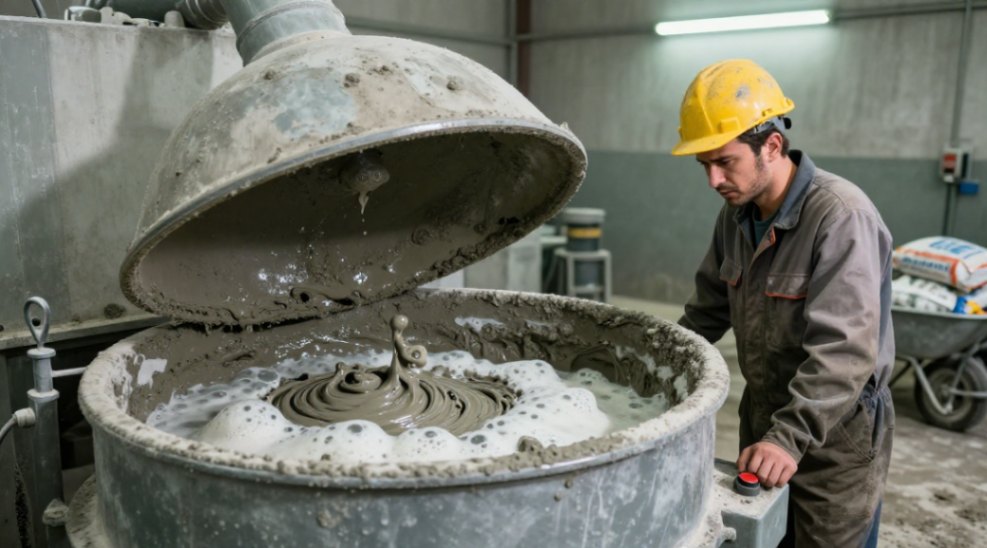
Foam collapse is the number one failure point. Think of your concrete foaming agent as a delicate soap bubble. It creates air voids that make the concrete light. If those bubbles pop, you get heavy, dense concrete with no insulation value. We see this most often when people use a cheap synthetic foaming agent and a high-shear mixer. The synthetic agent creates a thin bubble membrane. It pops like a balloon when hit by the sharp edges of a mixing paddle. You need a foam generator that creates a tight, stable bubble, and you need a mixing method that is gentle. Use a pre-formed foam method instead of mixed-in-place foaming. This keeps the foam stable until it hits the cement. The foam must survive the journey into the mixer.
Our fix: Always test your foam stability. Fill a bucket with foam. Time how long it takes for the first 10 mm of liquid to drain from the bottom. If it drains in under 2 minutes, you have a problem. Either switch to a protein-based foaming agent (more stable but more expensive) or reduce your mixing time to under 90 seconds.
2. Can I Just Use Any Cement For Lightweight Concrete?
No. You cannot. Using the wrong cement is a fast track to segregation and weak corners.
We have seen teams grab whatever special cement is on the truck. Bad idea. Your cement fineness and chemical composition directly affect foam stability. A coarse cement (like a Type I/II with low Blaine fineness) will sink like a rock. The heavy particles fall, the foam rises, and you get a layered mess. You need a finer cement or you need to add supplementary materials like fine fly ash or silica fume. These finer particles physically support the foam bubbles during the plastic state. They hold the bubble in place. A high-alkali cement can also attack the foaming agent itself. Check your cement chemistry. A low-alkali, high-fineness cement is your safest bet.
Our fix: If you must use a coarse cement, add a superplasticizer or concrete water reducer to improve the paste workability and reduce water. A thicker paste holds foam better. Do not add extra water to improve flow. That is a killer for foam stability.
3. How Do I Get The Density Right (300–1200 kg/m³)?
You cannot guess density. You must weigh it. Every. Single. Batch.
We have made this mistake ourselves. You think you know the foam dosage, but your foamed concrete comes out 50 kg/m³ too heavy. That extra weight kills your thermal insulation values. It adds load to the structure. Getting the density right is a simple equation: Target density = (Cement + Water + Sand + Foam). The foam is just air. You control density by controlling the foam volume. But here is the trap: foam is compressible. If you pump it, you lose volume. If you mix it too long, you lose volume. You must measure the actual wet density of your mix, not the theoretical one.
| Target Wet Density (kg/m³) | Typical Compressive Strength (MPa) | Foam Volume (% of total) | Primary Application |
|---|---|---|---|
| 300 – 500 | 0.5 – 1.5 | 70 – 80% | Thermal Insulation, Void Filling |
| 600 – 900 | 1.5 – 4.0 | 50 – 65% | Floor Screeds, Roof Insulation |
| 1000 – 1200 | 4.0 – 8.0 | 30 – 45% | Precast Blocks, Structural Fill |
Our fix: Use a calibrated bucket. Weigh your wet concrete immediately after mixing. Adjust your foam volume up or down based on that real weight. Document every batch. This is non-negotiable quality control.
4. Protein-Based vs. Synthetic Foaming Agent: Which One Do I Choose?
Here is the truth: Protein agents are built for strength. Synthetic agents are built for cost.
We get asked this every week. The choice is simple depending on your priority. Are you making lightweight blocks that need to hold a nail? Use a protein-based agent. The bubbles it creates are smaller and more uniform. This gives you higher compressive strength at the same density. Are you filling an abandoned sewer pipe? Use a synthetic agent. It is cheaper and the strength requirement is near zero. Protein agents are made from animal by-products. They smell. They are more expensive. But they are more stable and give you a better bubble size distribution. Synthetic agents (based on sodium lauryl sulfate or similar) are cheap and odorless, but they produce larger, less stable bubbles. For structural light weight concrete, go protein or a high-grade synthetic. For non-structural fill, go standard synthetic.
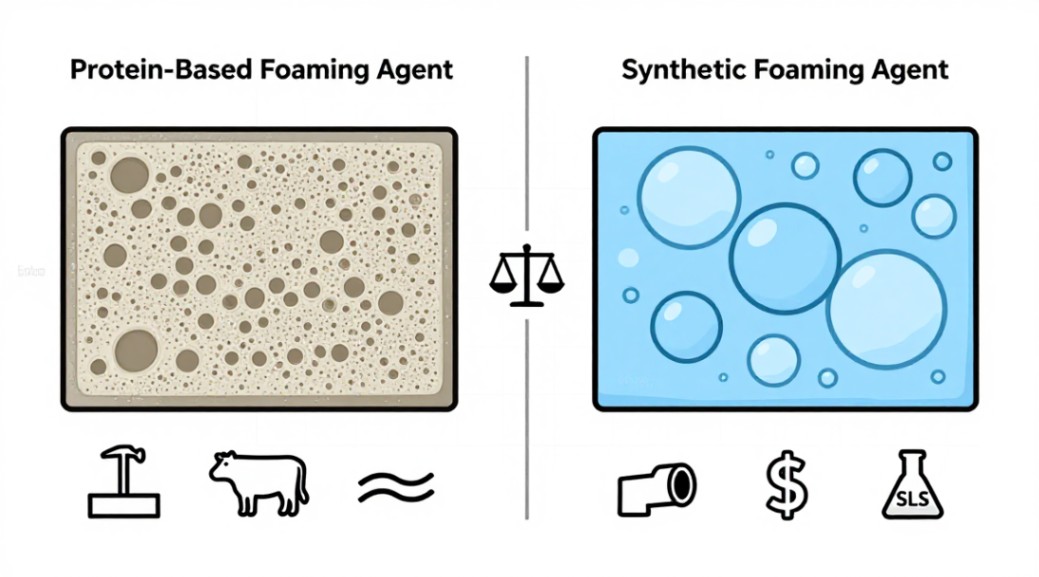
Our fix: Run a side-by-side test. Make two test batches at your target density. Cure for 7 days. Test compressive strength. If the protein agent gives you 3.0 MPa and the synthetic gives you 1.8 MPa, you have your answer. The cost difference is small compared to a structural failure.
5. Why Is My Foamed Concrete Cracking?
Shrinkage cracking is a sign of bad water control or missing fibers.
Cracks in foamed concrete are not always a structural issue, but they always look bad and can leak. The main cause is drying shrinkage. Foamed concrete has a lot of air, but it also has a lot of water. That water has to leave. When it leaves, the concrete shrinks. If the shrinkage is restrained (by the substrate or by reinforcing), it cracks. We prevent this by using early strength agent to accelerate the set, reducing the time the concrete is weak. More importantly, we add fiber. Polypropylene fibers at a low dosage (0.5–1.0 kg/m³) hold the concrete together during plastic shrinkage. They act like micro-reinforcement.
Our fix: Do not over-water the mix. Use a concrete water reducer to keep water low. Add fibers. And for large slabs, use control joints every 3–4 meters. If the concrete is still cracking, check your concrete defoamer contamination. If your tools or forms are coated with a defoamer (like a diesel-based release agent), it will kill the foam at the surface and also cause delamination and cracking.
6. Can I Add Other Chemicals To Speed It Up?
Yes, but you must be careful. Not all admixtures play nice with foam.
This is a common pitfall. You want to speed up the set to get your formwork off sooner. You add a calcium chloride accelerator. Suddenly, your foam is gone. Some accelerators, especially those with high chloride or high nitrate content, react with the surfactant in the concrete foaming agent. They destabilize the bubble. The same is true for some superplasticizer formulations. If you add a polycarboxylate ether (PCE) superplasticizer, make sure it is compatible. Some PCEs can defoam the mix. We always recommend using a naphthalene-based superplasticizer as a safer starting point. It is older technology, but it is more foam-friendly.
Our fix: Test everything first. Put your proposed mix (cement + water + admixture) in a blender. Add a fixed amount of foam. See if it survives. A simple visual test can save you a truckload of scrap. For accelerating set, use a non-chloride early strength agent designed for cellular concrete. Many suppliers offer a stable package.
7. Is The Foam Generator Really That Important?
Absolutely. Your foam generator is the heart of the operation.
You cannot make good foamed concrete with a bad foam generator. We have seen people try to use a garden sprayer or a shop vac. It does not work. A proper foam generator forces the foaming agent solution (typically 1-5% concentration in water) through a mesh or a packed column under controlled air pressure. This creates uniform bubbles. Without consistent bubble size, your concrete density will be inconsistent. The foam will be weak. You need a generator that gives you a consistent flow rate and a tight bubble structure. A pre-foaming method is almost always superior to mixed-in-place for quality control. You can adjust the foam density at the generator. Aim for a foam density of 50–80 g/L (grams per liter). That is a good target.
Our fix: Calibrate your foam generator every day. Measure the foam output in liters per minute. Measure the foam density. If it changes, clean the generator. A dirty nozzle or clogged mesh is the most common cause of foam inconsistency. Invest in a good generator. It pays for itself in waste reduction.
Your Next Move: Test Small, Then Build Big
Here is our final piece of advice, earned from 20 years of messing this up ourselves. Never scale a job from a lab test to a full pour without a field trial. The real world is different. Your batch plant mixer is different. The temperature is different. The water pH is different. Make a 1 cubic meter test pour. Cores it. Test it. Only then commit to the full job. You want to catch a mistake with a wheelbarrow, not a concrete pump truck. Trust us on this one. The difference between a successful project and a failed pour is almost always in the preparation and the quality of your concrete foaming agent and your foaming equipment. Get those two things right, and the rest falls into place. For specific chemical compatibilities, you might need to consult a specialist supplier like TRUNNANO for their nano-modifier or redispersible polymer powder to further refine your mix design, but remember: start with the fundamentals of foam stability and density control. That is your foundation.
We are the global leader in lightweight concrete and advanced engineered foam solutions. Known globally for its commitment to research, innovation, and applied expertise, we have been providing engineered foam solutions since the early 2012’s.
We can supply high-quality concrete admixture and foam concrete related products all over the world.
The company has a professional technical department and quality supervision department, a well-equipped laboratory, and equipped with advanced testing equipment and after-sales customer service center.
If you are interested, please feel free and contact us.