Professional solutions on concrete addtives, Concrete Foaming Agent, Superplasticizer, CLC Blocks Additives, and foaming machine

Building Higher, Stronger, Lighter: The Structural Case for Expanded Clay Aggregate Concrete
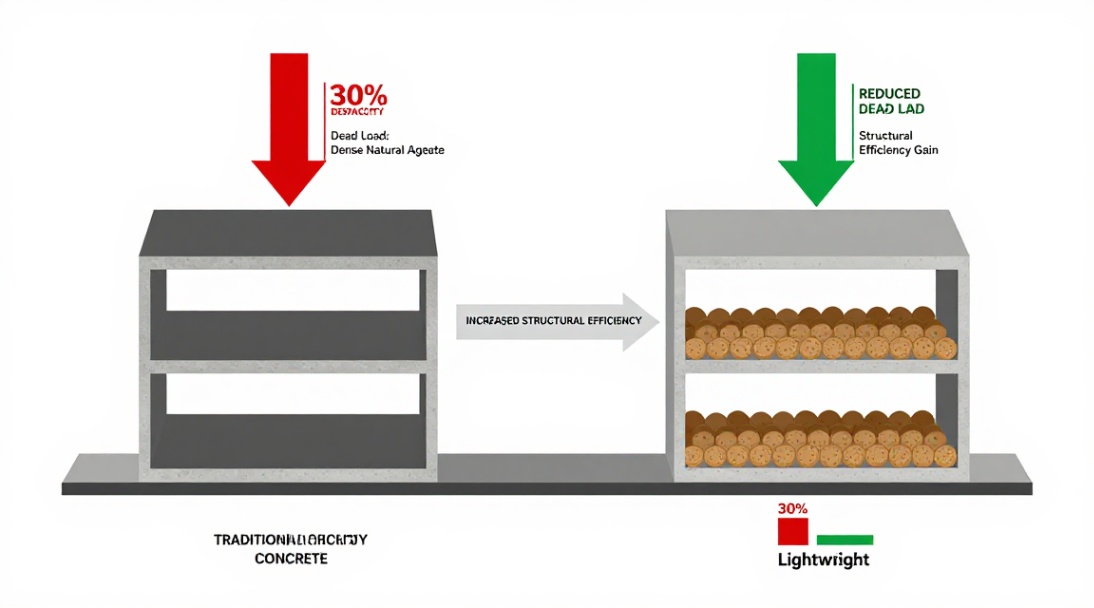
Modern steel-reinforced concrete structures routinely dedicate over 30% of their design capacity to carrying the weight of their own floors. This statistic isn’t just a technical footnote; it’s a multi-billion dollar inefficiency baked into our skyline. Structural lightweight concrete with expanded clay aggregate challenges this fundamental waste. By replacing dense natural aggregates with engineered, porous clay pellets, it delivers a material that is genuinely structural, not just insulating filler.
Redefining Strength-to-Weight
This isn’t your father’s lightweight concrete. We’re talking about mixes achieving consistent compressive strengths of 4,000 to 8,000 psi (28 to 55 MPa) with densities ranging from 90 to 115 lb/ft³ (1,440 to 1,840 kg/m³). The key is the aggregate: expanded clay, shale, or slate, fired in rotary kilns to create a hard, ceramic shell around a closed cellular structure. This delivers a structural lightweight concrete that performs, not just pretends.
The Core Advantage: A Material Comparison
Let’s cut through the marketing. The value of expanded clay aggregate concrete becomes undeniable when placed side-by-side with conventional mixes. The following table breaks down the critical differentiators.
| Parameter | Normal-Weight Concrete (NWC) | Structural LWAC with Expanded Clay |
|---|---|---|
| Oven-Dry Density | 145-155 lb/ft³ (2320-2480 kg/m³) | 90-115 lb/ft³ (1440-1840 kg/m³) |
| Typical Strength Range | 3,000 – 10,000+ psi | 4,000 – 8,000 psi |
| Thermal Conductivity (k-value) | High (~0.8-1.0 W/m·K) | Low (~0.3-0.5 W/m·K) |
| Fire Resistance Rating | Standard | Superior (Ceramic aggregate does not burn) |
| Primary Structural Benefit | High ultimate strength | High strength-to-weight ratio |
| Constructability Impact | Heavy formwork, larger foundations | Reduced foundation size, easier handling |
Beyond the Mix Design: The Ripple Effect
The initial cost per cubic yard for lightweight aggregate concrete is higher. Full stop. But structural engineering is a systems game. A 35% reduction in dead load triggers a cascade of savings. Column and footing cross-sections shrink. Reinforcing steel tonnage drops. Foundation costs plummet. In seismic zones, reduced mass means lower inertial forces, allowing for more elegant and economical lateral systems. The feedback on engineering forums like Reddit is consistent: once the total project economics are modeled, the premium for the material often vanishes. One project manager noted, ‘We saved more on the foundation redesign and crane time than we spent on the upgraded concrete mix.’
The Sustainability Calculus That Matters
Discussions about ‘green’ concrete often get lost in vague percentages of recycled content. The sustainability argument for expanded clay aggregate is more direct and powerful. First, the production is a kiln-based process, not quarrying. It can use clay sources unsuitable for other purposes. Second, and most critically, the thermal mass of a building envelope built with insulating structural concrete performs a double duty. It carries load and significantly reduces operational energy demands for heating and cooling. The lifetime carbon savings from this embodied insulation often outweigh the initial production energy input. This is a material that pays back.
Handling Truths and Application Realities
It’s not magic. It demands respect. The mix design is paramount. The pre-wetted aggregate absorbs water from the mix; you must account for this absorption to avoid a harsh, unworkable batch. Pumping requires stable mix designs to prevent segregation. Finishing timing differs—the surface may ‘crust’ faster due to internal absorption. But these are not barriers. They are standard procedures for any competent concrete crew after a single project’s learning curve. Its ideal applications are unmistakable:
- High-Rise Construction: Reducing floor weight increases story count or allows for more slender, elegant designs.
- Long-Span Bridges: Lighter deck concrete reduces the size and cost of supporting girders and piers.
- Precast & Prestressed Elements: Lighter panels and beams mean easier transport, faster erection, and lower crane capacity requirements.
- Retrofitting and Overlays: Adding floors to existing structures where foundation capacity is limited.
The Future is Lightweight
The trajectory is clear. As construction pushes into more challenging environments—softer soils, seismic zones, denser urban infill—the penalty for dead weight grows. Research isn’t just about higher strengths; it’s about smarter aggregates. Expect tighter grading control, engineered surface textures for improved bond, and hybrid systems combining expanded clay with other lightweight aggregates for optimized performance. The era of hauling millions of tons of unnecessary rock to a job site is ending.
Your next project has a weight problem you haven’t quantified yet. The question isn’t whether you can afford to specify structural lightweight concrete with expanded clay aggregate. The question is whether you can afford not to model it. The data, the case studies, and the physics are unequivocal. Run the numbers on your specific scheme. Compare the total structural system cost, not just the line item for concrete. The results will force a rethink.
We are the global leader in lightweight concrete and advanced engineered foam solutions. Known globally for its commitment to research, innovation, and applied expertise, we have been providing engineered foam solutions since the early 2012’s.
We can supply high-quality concrete admixture and foam concrete related products all over the world.
The company has a professional technical department and quality supervision department, a well-equipped laboratory, and equipped with advanced testing equipment and after-sales customer service center.
If you are interested, please feel free and contact us.