Professional solutions on concrete addtives, Concrete Foaming Agent, Superplasticizer, CLC Blocks Additives, and foaming machine

How to Use a Portable Foam Generator to Solve Your Toughest On-Site Concrete Challenges
A Better Way to Make Lightweight Concrete
We all know ordering too much concrete is expensive, and ordering too little halts a project. But here’s a figure that makes us rethink everything: industry analysis suggests that material waste from over-ordering and incorrect mix proportions for specialized concrete can eat up to 15% of a project’s material budget. That’s money poured straight into the ground. For tasks requiring precise, low-density fills or lightweight concrete, the rigid system of a fixed batching plant or a ready-mix truck often creates more problems than it solves.
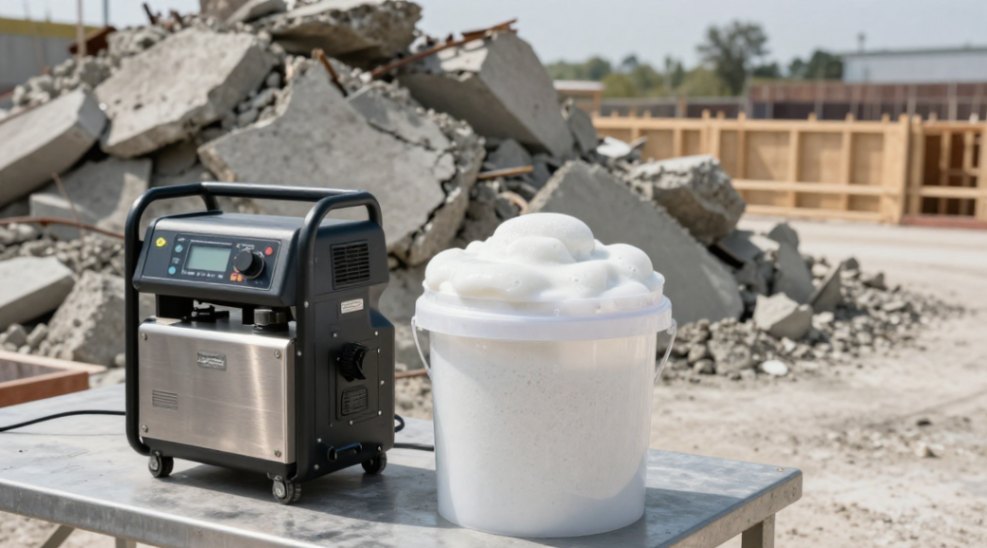
This is where the portable foam generator for on-site concrete production changes the game. It’s not magic. It’s control. You take control of the most critical variable in lightweight concrete: the air. By generating stable, microscopic foam on demand and injecting it directly into your mixer, you dictate the exact density and properties of the final product, right where you need it.
What Exactly Is a Portable Foam Generator?
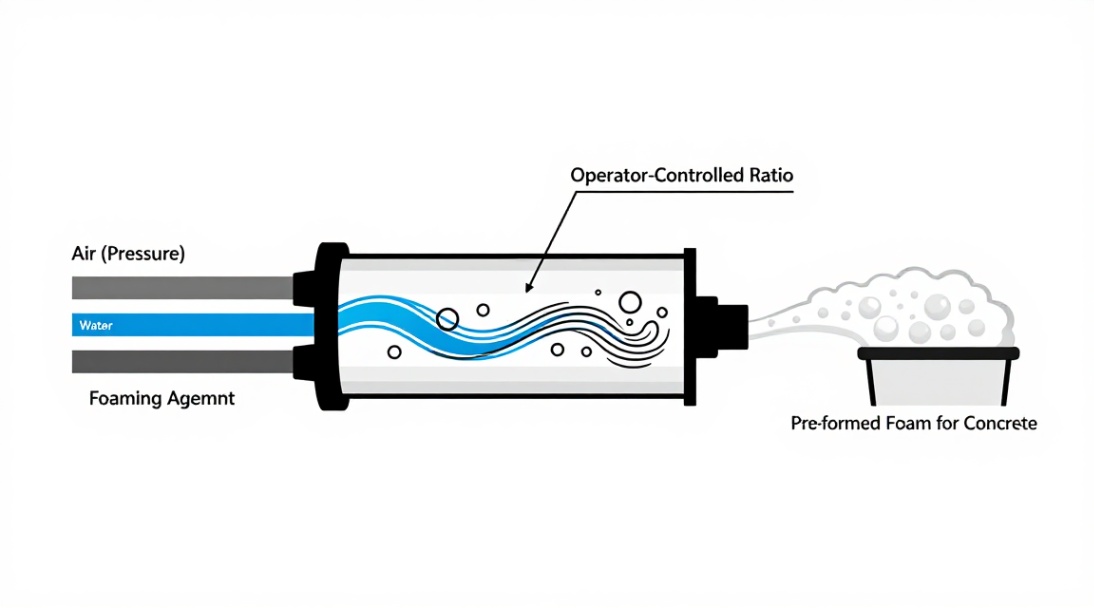
At its core, a portable foam generator is a compact, self-contained unit designed to produce a high-volume of pre-formed foam from a concentrated liquid foaming agent. The basic operational principle is straightforward but precise. It blends a precise ratio of foaming agent and water with a high volume of compressed air. This action creates a wet, shaving-cream-like consistency filled with millions of tiny, uniform air bubbles. This foam is then piped directly into a standard mixer containing your base slurry of cement, sand, and water.
Core Components You Need to Know
Every system revolves around three key parts working in harmony.
- The Generator Unit: This is the heart. It houses the proportional dosing pump for the foaming agent, water inlet, and the mixing chamber where air and liquid collide to create foam.
- The Foaming Agent: This is the specialized chemical. Don’t confuse it with air-entraining admixtures. A true foaming agent is designed to be pre-foamed, creating a separate, stable cellular structure before it ever touches the cement.
- The Compressed Air System: This is the lungs. A consistent, dry supply of compressed air (typically from a standard site compressor) is non-negotiable. The air volume and pressure directly control foam expansion and bubble structure.
Step-by-Step: Setting Up and Running Your Generator On-Site
Success with a portable foam generator for on-site concrete production relies on methodical setup. Skipping steps leads to inconsistent foam and failed concrete.
Step 1: Site Setup and Connection
First, position the generator near your mixer. You’ll need three key resources connected reliably.
- Power Source: Most units run on 110V or 220V single-phase power. Ensure you have a dedicated, grounded circuit.
- Water Supply: Connect a clean, potable water hose. Consistent water pressure is critical for proper proportioning with the foaming agent.
- Compressed Air: Hook up a dry, oil-free air line from your compressor. Check the required PSI and CFM for your specific generator model and ensure your compressor can meet it continuously.
Step 2: Calibration and Initial Foam Production
Before you touch any cement, you must dial in your foam. This is the most important step.
Fill the foaming agent tank. Turn on the water and air. Adjust the dosing pump to the manufacturer’s recommended dilution ratio (e.g., 1:30). Start the generator and produce foam into a bucket. You’re looking for foam that holds its shape, doesn’t drain water quickly, and has a fine, uniform bubble structure. This is your “baseline foam.” Adjust the air-to-liquid ratio if the foam is too wet or too dry. Record your settings.
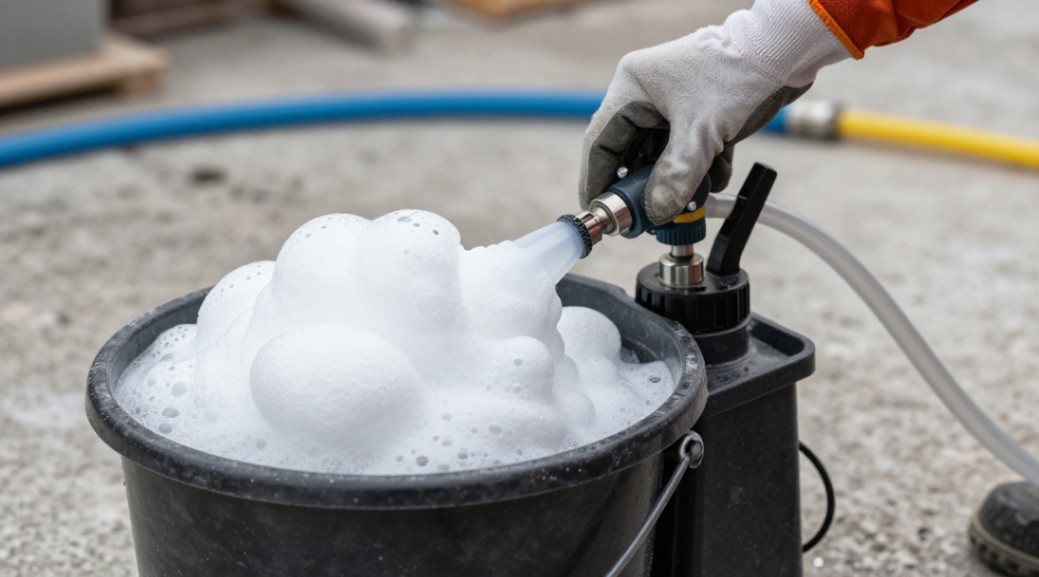
Step 3: Integrating with Concrete Production
Now, integrate with your mixing operation.
- Charge your mixer (standard drum mixer or volumetric truck) with the correct amounts of water, cement, and sand to create your base slurry. Mix thoroughly.
- Start the foam generator. Introduce the foam hose into the mixer while it is running.
- Inject the foam gradually. Stop periodically to check the volume and consistency. The concrete will visibly expand and lighten in color.
- Mix for an additional 2-3 minutes after foam addition to ensure complete, uniform distribution. Do not overmix, as this can start to break down the foam bubbles.
Step 4: On-Site Mix Design Adjustment
This is your superpower. Need a slightly lower density? Add more foam. Need a bit more strength for the next pour? Reduce the foam volume slightly and adjust your cement content. You make these decisions in real-time, based on the previous batch’s performance. Always cast test cylinders or cubes on-site to verify compressive strength against your design specs.
Where This On-Site Control Truly Shines
This method isn’t for every slab. It excels in specific, high-value applications where control and adaptability are paramount.
- Lightweight Fill (CLSM): Creating controlled low-strength material for trench backfill, void fill, or raising slab elevations. You can target exact flowability and a set final density that won’t settle.
- Insulating Concrete Roof Decks or Floor Screeds: Producing stable, low-density concrete with consistent thermal properties across the entire pour.
- Precast Elements: Manufacturing lightweight blocks, panels, or architectural elements where weight reduction is critical.
- Remote or Access-Limited Projects: Sites where ready-mix trucks can’t reach. You bring the generator, bulk cement, sand, and foaming agent to produce lightweight concrete locally.
Thinking About Cost? Look at Total Project Economics
The initial investment in a quality portable foam generator is a fraction of the cost of a fixed plant. The real savings are operational and material-based. You eliminate per-yard premiums for specialty lightweight mix designs from ready-mix suppliers. You drastically cut waste by mixing only what you need, when you need it. You reduce trucking costs for remote sites. For repetitive or specialized work, the payback period can be surprisingly short. As one veteran project manager put it, “The generator pays for itself not in the first project, but in the avoided headaches and change orders on every project after.”
Keeping It Running: Maintenance and Troubleshooting
Treat the generator like any other critical site tool. After each day, run clean water through the system to flush out any residual foaming agent. Check seals and connections monthly. The most common issue is poor foam quality.
- Foam is too wet and drains quickly: Likely too much water or not enough air. Check your dilution ratio and increase air pressure/volume.
- Foam is dry and collapses: Not enough water or too much air. Adjust the dosing pump to increase foaming agent/water mix.
- Inconsistent foam output: Check for clogs in the foaming agent pick-up tube or a fluctuating water pressure supply.
Operator training is essential. The person running the generator must understand the relationship between air, water, agent, and the final concrete. It’s a skill, but one quickly mastered with hands-on practice.
Your Next Move
Forget the old constraints. If your projects involve lightweight fills, insulating concrete, or unpredictable site conditions, the ability to produce on-demand foam concrete is a fundamental skill shift. Start by reviewing your past projects that used CLSM or lightweight mixes. Calculate the total yards used, the cost per yard, and the logistical hurdles. Then, talk to a supplier who specializes in portable foam generators for on-site concrete production. Ask for a demo. Get your hands on the controls. Produce a batch of foam, then a batch of concrete. The control you gain isn’t just over density-it’s over your schedule, your budget, and your project’s success.
We are the global leader in lightweight concrete and advanced engineered foam solutions. Known globally for its commitment to research, innovation, and applied expertise, we have been providing engineered foam solutions since the early 2012’s.
We can supply high-quality concrete admixture and foam concrete related products all over the world.
The company has a professional technical department and quality supervision department, a well-equipped laboratory, and equipped with advanced testing equipment and after-sales customer service center.
If you are interested, please feel free and contact us.