Professional solutions on concrete addtives, Concrete Foaming Agent, Superplasticizer, CLC Blocks Additives, and foaming machine

Stop Digging Your Own Grave: The Shocking Truth About Cellular Concrete Trench Backfill & Void Fill
The Ticking Time Bomb in Your Trench
A recent industry survey by a major construction research body revealed that over 40% of utility damage during subsequent excavations traces back to the backfill material. The dirt, sand, or gravel you saved money on yesterday is the jackhammer blade and repair bill of tomorrow. This isn’t just inconvenient. It’s a costly, preventable failure. This article exposes the critical mistakes you’re probably making with cellular concrete for trench backfill and void fill. It also explains how to stop them.
Why Your ‘Industry Standard’ Backfill is a Liability
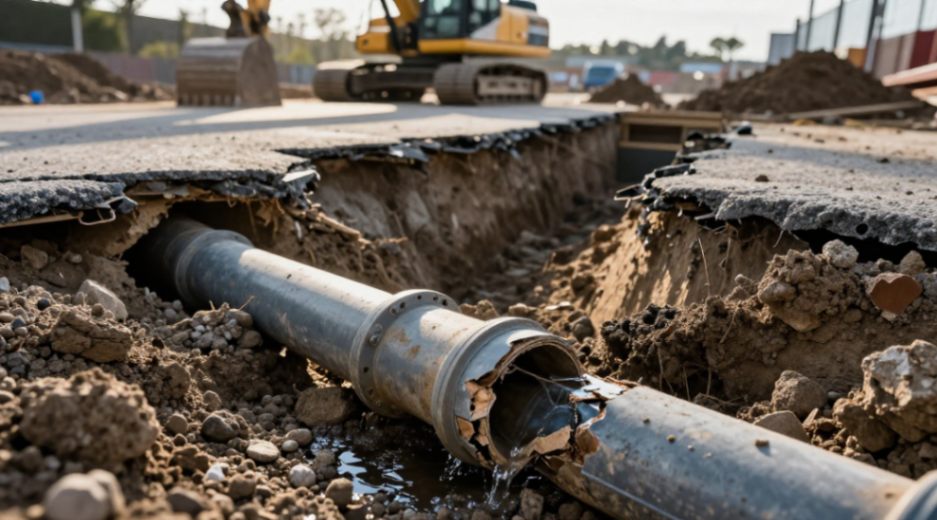
Traditional materials like compacted granular fill create a series of hidden risks. They settle. They create voids. They shift under hydrostatic pressure. Their performance depends entirely on the skill of the crew and weather conditions. You aren’t just filling a hole; you’re creating a future structural problem. Cellular concrete for trench backfill eliminates this gamble by providing a controlled, engineered fill.
The Cellular Concrete Advantage: Not Just Another Grout
Don’t confuse this with structural concrete. Cellular concrete is a lightweight, flowable fill. We make it by injecting a preformed foam into a cementitious slurry. This process creates millions of microscopic, stable air cells. The result is a material with properties that solve the core problems of traditional backfill and void fill applications.
Properties That Redefine Fill Performance
- Low Density: Typically 20-120 pcf. Dramatically reduces dead load on underlying utilities or unstable soils.
- High Flowability & Self-Leveling: It flows like thick pancake batter, filling every irregularity, void, and underground cavity without manual rodding or vibration.
- Controlled Strength: From non-load bearing (<20 psi) to load-bearing (50+ psi) mixes, we design the strength for the application, not guess.
- No Compaction: It cures to its placed density. Zero risk of improper compaction leading to settlement.
Choosing Your Weapon: Load-Bearing vs. Non-Load-Bearing Mixes
This is the most common specification error. Choosing wrong is like using packing peanuts as a foundation. The table below kills the confusion.
Critical Comparison: Selecting the Right Cellular Concrete Mix
| Application Scenario | Correct Mix Type | Wrong Choice & Consequence |
|---|---|---|
| Abandoning old sewer pipes, tanks, or culverts (pure void fill) | Non-Load-Bearing (15-30 pcf, <20 psi) | Using a heavy, high-strength mix. Wastes money, creates unnecessary load on adjacent structures. |
| Utility trench backfill under roads, parking lots, or slabs | Load-Bearing (35-50 pcf, 30-100 psi) | Using a weak, non-structural mix. Leads to pavement failure and surface settlement under traffic loads. |
| Filling large underground voids or unstable subgrade | Engineered Low-Density (20-35 pcf, 20-50 psi) | Using standard compacted fill. It will continue to settle and shift, failing to stabilize the matrix. |
The Process: Why Speed is Your Secret Weapon
The speed of cellular concrete for trench backfill installation isn’t just convenient. It’s a core financial and risk-management advantage. The process is ruthlessly efficient:
- Excavation & Prep: Excavate per spec. Remove water. That’s it. No importing select granular material, no building lifts.
- Direct Placement: The ready-mix truck pumps the material directly from its agitator into the trench or void. No conveyors. No crews shoveling.
- Instant Fill: The material flows, self-levels, and encapsulates the utility. It begins curing immediately.
- Rapid Return to Service: For non-structural fills, you can often backfill over the cellular concrete within hours. Pavement can be replaced in 24-48 hours depending on the mix.
The labor savings are staggering. A three-man crew with a pump replaces a crew of eight with compactors and stone.
Long-Term Benefits: The Peace of Mind You Can’t Buy
Forget maintenance. This is about permanent stability. Properly specified cellular concrete provides three critical long-term advantages that granular backfill can’t match.
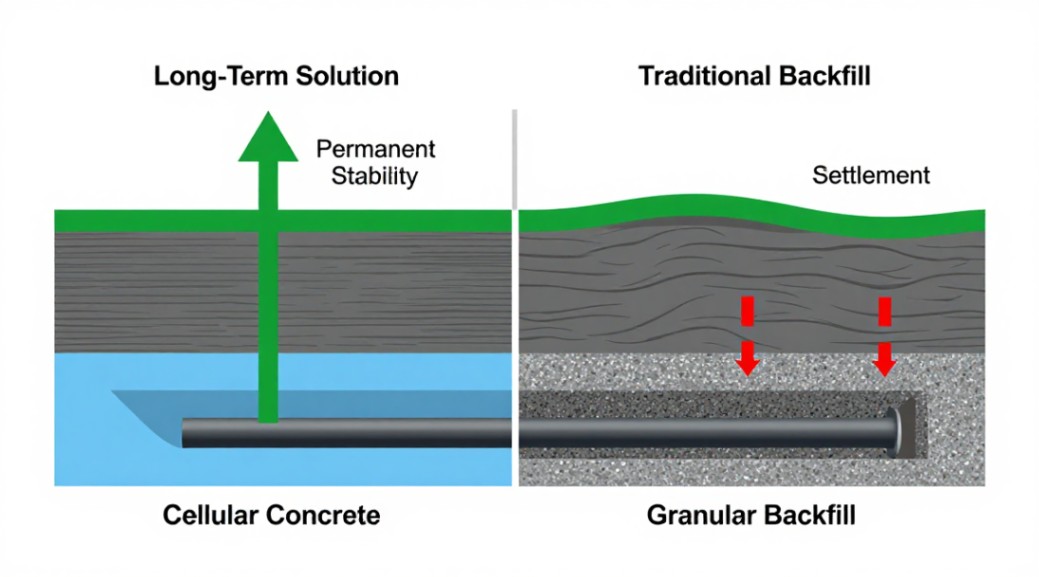
1. Absolute Non-Settlement
It does not compact further. The surface grade you establish on Day 2 is the surface grade in Year 20. This eliminates costly pavement patching and service callbacks.
2. Superior Utility Protection
The material forms a monolithic, non-corrosive, and non-reactive mass around pipes and conduits. It provides uniform support, eliminating point loads that cause pipe deflection and failure.
3. Future Excavation Made Easy
This is the counterintuitive genius. While strong in compression, cellular concrete is relatively easy to excavate with a backhoe or pneumatic tool-much easier than rock-hard, compacted soil. You protect the utility during its service life and make future access safer and cheaper.
The Real Cost Analysis: Looking Beyond the Invoice
Yes, the cubic yard price of cellular concrete is higher than dirt. This scares off bean-counters who don’t understand total installed cost. Let’s be blunt: you’re analyzing the wrong number. Compare these cost centers:
- Material & Hauling: Traditional fill often requires importing expensive select granular material. Cellular concrete uses on-site water and less cement than structural concrete.
- Labor & Equipment: Eliminate compactor rental, fuel, and the large crew to operate them. The pump does the work.
- Time & Traffic Control: Reducing a 3-day backfill operation to 4 hours has massive value in urban environments and on high-traffic corridors.
- Risk & Warranty: Price the cost of a pavement failure callback in 18 months. Price a utility strike during the next excavation. Cellular concrete slashes these latent liabilities.
When you run the real numbers, cellular concrete for void fill and trench projects often wins on total cost.
Critical Contractor Considerations: Don’t Get Burned
This isn’t a commodity you order from a catalog. Success requires front-end diligence.
- Specify Precisely: Your project specs must dictate density (pcf), compressive strength (psi) at 28 days, and flowability. “Cellular concrete” alone is insufficient.
- Vet Your Supplier: Not all concrete plants understand cellular mixes. Partner with a supplier who has a dedicated foam generator and a proven mix design for your application.
- Plan the Placement: Ensure the pump truck has clear access. Understand cure times before covering. A good supplier will guide you through this.
Your Next Move
Stop viewing backfill as a waste-disposal problem. Start viewing it as a permanent structural component. The data is clear: traditional methods introduce unacceptable long-term risk. For your next critical trench backfill project or complex void fill challenge like an abandoned tank or sewer line, demand a comparative cost analysis that includes labor, equipment, and risk. Insist on talking to an engineer or supplier who specializes in cellular concrete for trench backfill and void fill. The easiest dig is the one you never have to re-dig.
We are the global leader in lightweight concrete and advanced engineered foam solutions. Known globally for its commitment to research, innovation, and applied expertise, we have been providing engineered foam solutions since the early 2012’s.
We can supply high-quality concrete admixture and foam concrete related products all over the world.
The company has a professional technical department and quality supervision department, a well-equipped laboratory, and equipped with advanced testing equipment and after-sales customer service center.
If you are interested, please feel free and contact us.