Professional solutions on concrete addtives, Concrete Foaming Agent, Superplasticizer, CLC Blocks Additives, and foaming machine

Specifying Sulfate Resistant Cement for Marine Environments: A Practical Engineer’s Guide
A Hidden Threat in Seawater: The Startling Cost of Sulfate Attack
While chloride-induced corrosion of rebar dominates marine durability discussions, a less visible but equally destructive process claims a significant portion of concrete infrastructure failures. Industry surveys from major port authorities indicate that sulfate attack contributes to over 30% of premature deterioration in submerged and tidal zone concrete. This degradation often goes unnoticed until cracking, spalling, and loss of structural integrity become severe and irreparable. The silent progression of sulfate attack makes proactive specification and construction with sulfate resistant cement for marine environments not merely an option, but a foundational requirement for longevity.
What is Sulfate Resistant Cement?
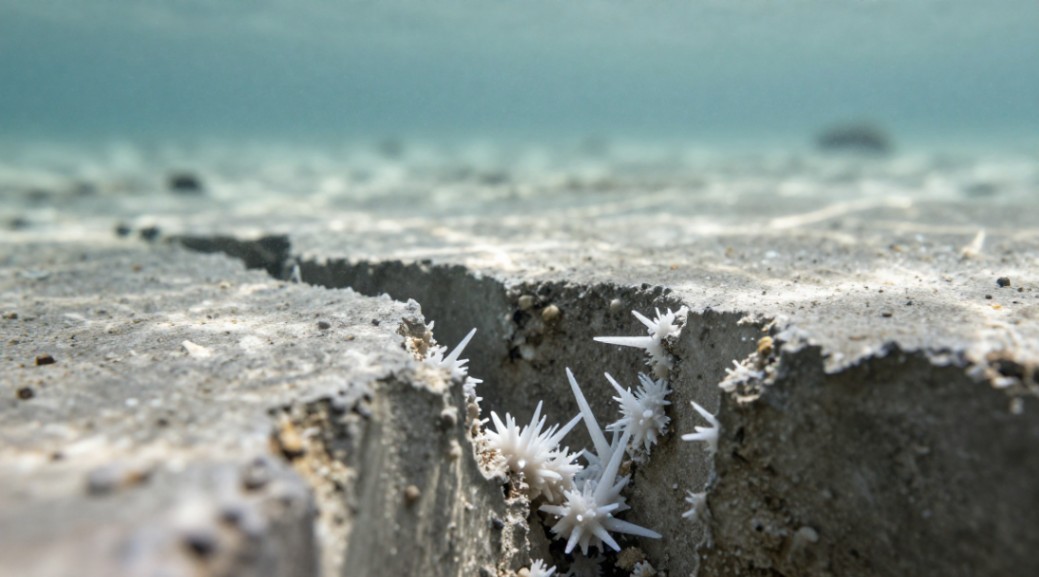
Sulfate resistant cement (SRC) is a specialized hydraulic cement engineered to resist chemical attack from sulfates present in seawater, groundwater, and soils. Its primary defense mechanism lies in its chemical composition. Unlike ordinary Portland cement (OPC), SRC is manufactured with a strictly limited content of tricalcium aluminate (C3A), typically below 5% and often as low as 3.5%. This is the critical compound that reacts aggressively with sulfate ions to form expansive, destructive ettringite crystals.
Core Composition and Standards
Engineers specify SRC according to established international standards that define its chemical and physical properties. The most common specifications are ASTM C150 Type V in the United States and the SR designation under EN 197-1 in Europe (e.g., CEM I SR). These standards mandate low C3A content and, in some cases, restrict the total alumina content. While the low C3A is the headline feature, achieving a dense, low-permeability concrete matrix through proper mix design and placement is equally vital for the cement’s performance.
Step-by-Step Guide to Specifying and Using SR Cement in Marine Projects
Success with sulfate resistant cement for marine environments depends on a holistic approach. The cement is a critical component, but incorrect use will nullify its benefits. Follow this procedural framework.
1. Project Assessment and Material Selection
First, classify the exposure severity. Permanent immersion, tidal/splash zones, and buried structures in sulfate-rich soils represent different risk levels. For severe marine exposure, specify ASTM Type V or EN 197-1 SR cement. Evaluate if supplementary cementitious materials (SCMs) like slag or fly ash are appropriate; they can further reduce permeability and enhance long-term sulfate resistance. In some aggressive cases, specifying a blended system incorporating sulfate resistant cement with SCMs creates a synergistic defense.
2. Mix Design for Low Permeability
SR cement alone is not a magic bullet. You must design the concrete mix for maximum density. This requires a low water-to-cementitious materials (w/cm) ratio, typically 0.40 or lower. Use high-quality, well-graded aggregates and consider a mid-range water reducer or high-range water reducer (superplasticizer) to achieve workability at this low w/cm. The goal is to create a concrete so dense that sulfate-laden water cannot easily penetrate it.
3. Precise Batching, Mixing, and Placement
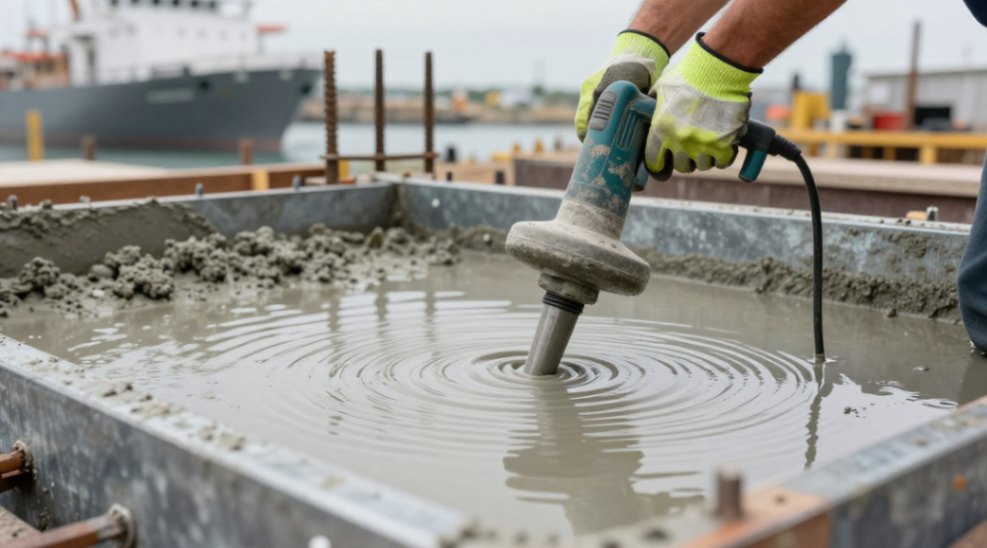
Strict quality control at the batching plant is non-negotiable. Ensure the correct cement type is delivered and stored separately to prevent contamination. Mixing time must be sufficient to achieve homogeneity. During placement, use proper consolidation techniques-vibration-to eliminate honeycombs and voids that become pathways for sulfate ingress. Avoid adding excess water on-site.
4. Critical Curing Procedures
Curing is where many marine projects fail. For sulfate-resistant concrete, extended, uninterrupted curing is mandatory to develop the dense microstructure it needs. Maintain the concrete in a moist condition for a minimum of 7 days, and 14 days is preferable in marine environments. Use wet burlap, curing blankets, or membrane-forming curing compounds applied immediately after finishing. Inadequate curing creates a permeable surface layer that undermines the entire design.
Integrating SR Cement into a Comprehensive Defense Strategy
For the most critical structures, treat sulfate resistant cement as the first line of defense in a multi-barrier system.
- Surface Coatings: High-performance epoxy or polymer-modified cementitious coatings provide an additional physical barrier against sulfate and chloride ingress.
- Cathodic Protection (CP): For reinforced concrete, CP systems actively prevent corrosion of the steel, addressing the chloride threat that SRC does not directly stop.
- Proper Detailing: Design details that minimize water ponding and ensure rapid drainage are essential. SR concrete cannot perform if it is constantly saturated due to poor geometry.
Comparison with Alternative Marine Concrete Solutions
Engineers often consider polymer-modified concrete (PMC) or high-performance concrete with SCMs. Each has its role. SR cement provides inherent, bulk resistance to a specific chemical threat and is well-suited for mass concrete elements like piles, seawalls, and foundations. PMC offers superior crack-bridging and adhesion, excelling in thin overlays or repairs. The most durable approach often combines the technologies: using SRC for the structural mass and PMC for protective toppings or in critical joint details.
Making the Durability and Economic Case
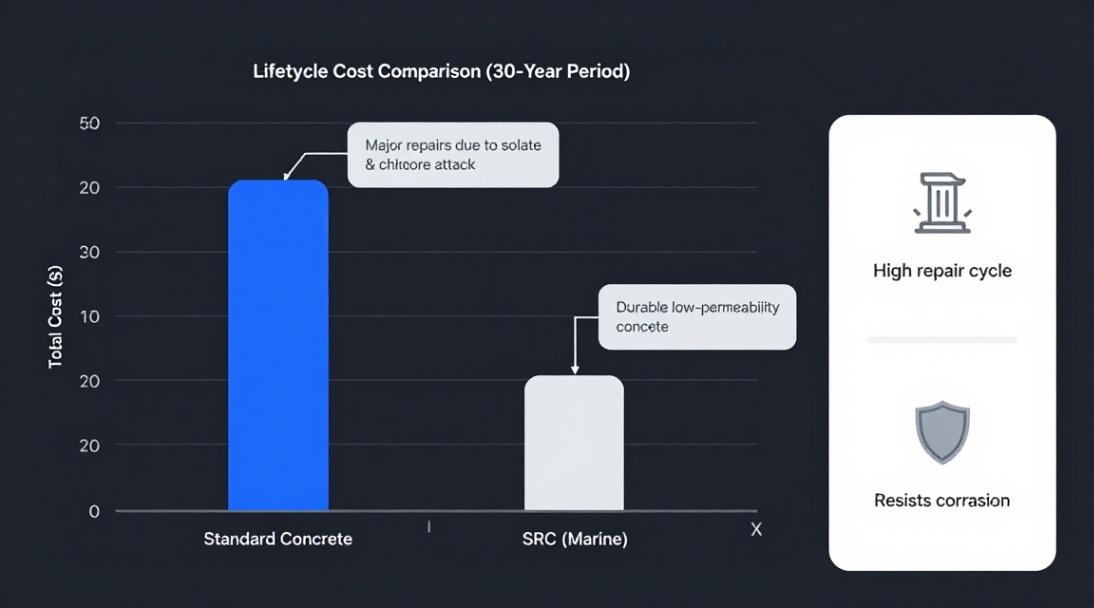
The initial cost premium for sulfate resistant cement for marine environments is typically 10-20% over standard cement. This investment must be evaluated against lifecycle costs. A study by the U.S. Army Corps of Engineers found that the lifecycle cost of a marine structure using appropriately specified durable concrete, including SRC, can be 3-5 times lower than one requiring major repairs within 20-30 years. The benefit is not just resistance to sulfate attack; the low-permeability concrete required for SRC performance also significantly slows chloride ingress and reinforcement corrosion.
Next Steps for Your Marine Project
Specifying the correct material is the first decisive action. Review your project’s exposure classification against ASTM C150 or EN 206-1. Engage with your ready-mix supplier early to confirm the availability of ASTM Type V or EN SR cement and to develop trial mixes that meet your required strength, workability, and permeability targets. For complex or high-risk applications, consult with a materials engineer specializing in concrete durability. The objective data is clear: a systematic, knowledge-based approach to sulfate resistant cement application is the most reliable path to achieving a marine structure that endures for its design life.
We are the global leader in lightweight concrete and advanced engineered foam solutions. Known globally for its commitment to research, innovation, and applied expertise, we have been providing engineered foam solutions since the early 2012’s.
We can supply high-quality concrete admixture and foam concrete related products all over the world.
The company has a professional technical department and quality supervision department, a well-equipped laboratory, and equipped with advanced testing equipment and after-sales customer service center.
If you are interested, please feel free and contact us.