Professional solutions on concrete addtives, Concrete Foaming Agent, Superplasticizer, CLC Blocks Additives, and foaming machine

Achieve Specified Strength in Cold Weather: A Technical Guide to Early Strength Concrete Admixtures
The Winter Construction Imperative
Winter concrete work is not about waiting for ideal conditions. It is about engineering the required conditions. Concrete cures through an exothermic chemical reaction called hydration. Cold temperatures slow this reaction dramatically, jeopardizing initial set and strength development. This delay exposes fresh concrete to freeze-thaw damage before it develops sufficient internal strength, leading to permanent structural defects and surface scaling. The financial and logistical impact of a halted project in December can be catastrophic. Early strength concrete admixtures for cold weather provide the targeted acceleration needed to overcome these thermodynamic realities. These chemical solutions modify the hydration kinetics, ensuring the concrete matrix gains protective strength within the critical first 24 to 48 hours, regardless of ambient air temperature. They are not a mere convenience; they are a fundamental risk-mitigation tool for cold weather concrete placement.

The Chemical Mechanisms of Cold Weather Acceleration
Understanding the chemistry is non-negotiable for effective use. These admixtures function primarily as accelerators. Traditional accelerators like calcium chloride (CaCl₂) work by increasing the ionic concentration in the mix water, which directly accelerates the reaction of the silicate phases (C3S) in cement. While highly effective, chloride ions introduce corrosion risk for embedded steel. Modern practice demands non-chloride, nitrate-based or nitrite-based accelerators for reinforced concrete. These alternatives provide a similar acceleration by altering the early hydration pathways without introducing corrosive elements. A secondary, often misunderstood function is depression of the freezing point of the mix water. By lowering the freezing point of the pore solution, these admixtures protect the concrete from internal ice crystal formation during the initial, most vulnerable plastic state. This is a critical safeguard during transport and placement before hydration heat builds sufficiently.
Integration with Cold Weather Concreting Protocols
An early strength admixture is a single component in a holistic cold weather concreting plan. It is not a substitute for proper protocols, but a powerful force multiplier for them. The American Concrete Institute (ACI) 306R guide defines cold weather as three consecutive days where the average daily air temperature falls below 40°F (4°C). Under these conditions, a multi-pronged approach is mandatory. The admixture accelerates internal chemistry. External protection retains the generated heat. Insulated blankets or heated enclosures work in concert with the admixture to maintain an adequate temperature envelope around the concrete member. This synergy is vital. A 2018 industry analysis by the National Ready Mixed Concrete Association found projects combining non-chloride accelerators with ASTM C171 insulated blankets achieved 75% of specified compressive strength 40% faster in 30°F (-1°C) conditions than using insulation alone. The admixture buys you time and strength; the insulation conserves that thermal energy.
Dosage, Compatibility, and Critical Standards
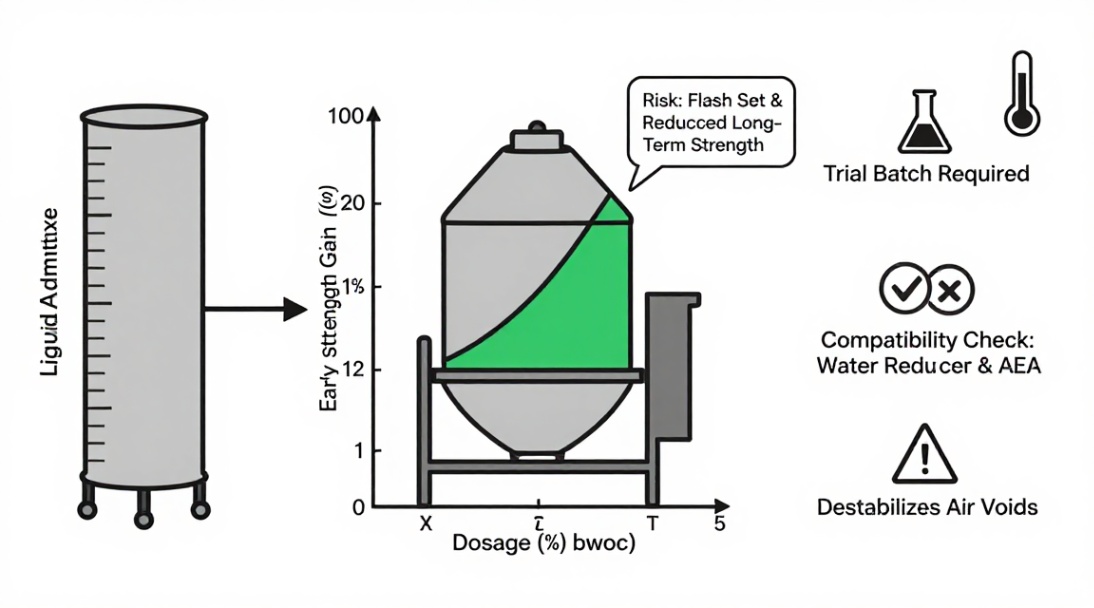
Precision dictates performance. Dosage rates for early strength concrete admixtures for cold weather are typically expressed as a percentage by weight of cementitious materials (% bwoc). Common ranges for non-chloride accelerators are between 1% and 3% bwoc. Exceeding recommended dosages can lead to flash set, excessive shrinkage, or reduced long-term strength. You must conduct trial batches with your specific mix design before field deployment. Compatibility with other admixtures, particularly water reducers and air-entraining agents (AEAs), is not guaranteed. The accelerated hydration can destabilize air void systems. Always add the accelerating admixture to the mix water or aggregates before introducing cement, and add AEA last. This sequence minimizes interaction conflicts. All materials and protocols must conform to relevant standards. For admixtures, this is ASTM C494, which defines performance requirements for Type C (accelerating) admixtures. For overall cold weather practice, follow ACI 306R and ASTM C31 for curing and testing specimens in field conditions.
Practical Application: A Case Narrative
Consider a bridge deck pour scheduled for late November. The forecast predicts temperatures dropping to 25°F (-4°C) overnight. The specification requires 3000 psi compressive strength before the deck can be opened to construction traffic. The concrete mix utilizes a 1.5% bwoc dosage of a nitrate-based accelerating admixture. Ready-mix trucks are fitted with insulated covers. Upon placement, crews immediately cover the finished deck with insulated curing blankets. Temperature probes embedded in the slab monitor core temperature. The admixture ensures rapid initial set and early strength gain, generating internal heat. The blankets trap this heat, maintaining a concrete temperature above 50°F (10°C). Maturity testing confirms the deck reaches 3000 psi in 60 hours, compared to the projected 7+ days without intervention. The pour is successful. The schedule is intact. The integrity of the deck is preserved, with no thermal shock or freeze damage. This is the standard outcome when theory is applied with disciplined execution.
Conclusion and Required Action
Early strength concrete admixtures for cold weather transform winter from a construction barrier into a manageable variable. Their correct application safeguards structural quality, protects financial investments, and ensures project continuity. The data and decades of field evidence are unequivocal. Do not gamble with winter weather. Integrate a performance-proven, non-chloride accelerating admixture into your cold weather concreting specification. Consult with your concrete supplier and admixture technical representative to design a site-specific protocol. Review the case study data from your admixture provider. Request a trial batch to verify performance with your local materials. Make the engineered solution your standard operating procedure for all concrete placements where the temperature falls below 40°F (4°C). Your project’s integrity depends on this decision. Start the conversation with your technical partner today.
We are the global leader in lightweight concrete and advanced engineered foam solutions. Known globally for its commitment to research, innovation, and applied expertise, we have been providing engineered foam solutions since the early 2012’s.
We can supply high-quality concrete admixture and foam concrete related products all over the world.
The company has a professional technical department and quality supervision department, a well-equipped laboratory, and equipped with advanced testing equipment and after-sales customer service center.
If you are interested, please feel free and contact us.